Category Archives: Evolution

Quick Post: Voices on the Net

Whoo! The Powers That Be keep inventing deadlines for me, so I will feed the blagobeast with a quick, quote-heavy post. Mark Chu-Carroll’s review of Behe’s The Edge of Evolution has attracted the attention of some creationist trolls, and some of the responses have been both memorable and pithy.

A mysterious being known only as Xanthir, FCD said the following:

As Mark implied, the distinction between micro- and macro-evolution is artificial and false. It amounts to drawing a line in the sand and saying, “Evolution can change things this much, but no further.” It says this without any reason why evolution wouldn’t be able to go past that point, and what’s more flies directly in the face of reams of actual data. It’s basically akin to splitting math into micro- and macro-arithmetic, and saying that numbers greater than a billion are part of macro-arithmetic and don’t occur through natural counting processes, and thus things that involve numbers past that line must have been created whole rather than building up from smaller quantities. The problem with that, of course, is that you can always add 1. Same thing here — you can always add one more mutation.

If you prefer the point made by early-1990s music video, see my earlier post, “Square One on Infinity” (and don’t say I didn’t warn you).

For the standard TalkOrigins critiques of the creationist micro/macro ploy, see here and here.

1 / 3 = 30%

OK, there’s so much to pick on in the Creation “Museum” that it constitutes a classic “target-rich environment,” but one of Media Czech’s photos is just too good to pass up:

Click to enlarge

First, I think rounding off to one significant figure represents a great advance for creationist mathematics. Dividing 1 by 3 to get 30% is a big improvement over their other, ahem, arithmetic issues (insisting on 6,000 when the actual figure is 13.7 billion, for example). Second. . . .
Continue reading 1 / 3 = 30%

Behe’s Bad Arithmetic and Worse Science

Blogging on Peer-Reviewed ResearchI would like to celebrate the official release date of Michael Behe’s new book, The Edge of Evolution, by pointing out a grotesque factual error in its very heart.

A major theme, if not the major theme, of Behe’s diatribe is the disease known as malaria. He wants to prove that evolution by natural means of any but the most trivial features of living things is completely impossible, and he uses the parasites which cause malaria as his test case. Unfortunately for him, but happily for the decades of scientific discovery which he tries to condemn, the mistakes in his argument tear it asunder.

Since Behe’s argument is built upon malaria, and in particular the evolution of the parasite Plasmodium falciparum to be resistant to the drug chloroquine, we should look at what modern biology has learned about how chloroquine resistance evolved. As chloroquine was “the best and most affordable antimalarial drug” in the history of antimalarial drugs, the evolution of resistance to it — and the spread of that resistance throughout the world — poses a real problem, which scientists are naturally eager to investigate.
Continue reading Behe’s Bad Arithmetic and Worse Science

Chu-Carroll on Behe’s The Edge of Evolution

Dear Gentle Readers: At the bottom of this essay, I’m collecting links to reviews of Behe’s book The Edge of Evolution, replies to reviews and so forth.

Well, now the burden is off me, and I can devote my book-reviewing time to good books, like the works of Hector Avalos. Mark Chu-Carroll has reviewed Michael Behe’s new book, The Edge of Evolution. In short, it’s as bad as I thought it would be. When I first heard about it, the only information available was the flap copy: the publisher’s blurb and four laudatory quotes. I found that with a trivial amount of Web-searching, each laudator was revealed to be a creationist sympathizer — which didn’t bode well for the contents of the book itself. What, they couldn’t get even one serious biologist to say something good about it?

My prediction, although in principle falsifiable, was not falsified but instead borne out by further investigation. Don’t you love it when that happens?

Behe’s new book comes at an interesting time in the ongoing struggle against arrogant ignorance. Once upon a time, the law mandated that Genesis be taught in science classrooms; then came “equal time” for science and mystical anti-science, followed by “creationism” and “creation science” which then became “Intelligent Design,” about which we had to “teach the controversy.” (Of course, like a linear portrayal of biological evolution, this little “X followed by Y” story focuses only on one path, on a single twig of a ceaselessly diversifying bush. Just as there are still living descendants of the dinosaurs, there are still Old Earth Creationists, ideological descendants occupying their own branch of the phylomemetic tree.) After the thumping “Intelligent Design” got at Dover, many of us wondered how the opposition to reason would reinvent itself. One strategy, embraced by at least one twig, is to rebrand the very word evolution:
Continue reading Chu-Carroll on Behe’s The Edge of Evolution

Creation “Science” “Museum”

Well, yet another monument to human stupidity has opened its doors to the paying public. It reminds me of the Mencken character in Inherit the Wind: “Darwin was wrong — man is still an ape, and his creed is still a totem pole.”
Modified newspaper front page

Ken Ham’s Creation Museum has provoked the reality-based community to put fingers to keys. PZ Myers has collected their writings, providing a long, long list of links and excerpts. The National Center for Science Education has also collected reactions to Ken Ham’s museum.

Funnily enough, I just picked up a paperback copy of Neil Gaiman’s American Gods (2001), from a friend who’s jettisoning her fiction before moving to California, sunny land of graduate schools. In this novel, Gaiman presents his own theory of American roadside attractions:
Continue reading Creation “Science” “Museum”

Enhanced Circumlocution Techniques

Lately, there’s been a bit of a dust-up over at the ScienceBlogs schizophrenic hive mind over some statements by Mitt Romney. During the course of the kerfluffle, I started thinking about the slippery way words work, and how oddities in our relationships to words affect the way we interpret them. As the fracas was dying down, a related post zinged my way from a different quarter which motivated me to ramble about the whole affair.

It began with Michael Luo writing the following at the New York Times political blog “caucus.”

“I believe that God designed the universe and created the universe,” Mr. Romney said in an interview this week. “And I believe evolution is most likely the process he used to create the human body.”

He was asked: Is that intelligent design?

“I’m not exactly sure what is meant by intelligent design,” he said. “But I believe God is intelligent and I believe he designed the creation. And I believe he used the process of evolution to create the human body.”

Is this a good sign or a bad one? More exactly, does it signify a move from very bad to less so? Well, tough to say — I don’t think “close reading” is a very useful tool to apply to politicians’ statements. (If this were a letter from Thomas Pynchon, then yes, we should scrutinize it for every nuance of meaning, yet Romney is not a future Nobelist but rather an embryonic Nixon.) Whether a man can be an ally in the struggle for reason and critical thought depends not only upon his ideas, but upon the man himself.

As a person who is moderately informed about biology, I grow nervous when I hear people single out “the human body” for preferential treatment as the desired end product of the evolutionary process. Remember in Calvin and Hobbes when Calvin described the prehistory of Earth from 4.5 billion years ago until today and then announced, “Now, in 1988, there’s me. The acme of evolution!” Satire, almost twenty years ahead of its target. Remember Prometheus, sculpting humans out of clay and stealing fire because all the good tricks had been given to the other animals? The only noteworthy difference between the Greek story and the modern myth is that like Bill Watterson, the Greeks recognized how feeble our bodies are without feral claws and feline night-vision.
Continue reading Enhanced Circumlocution Techniques

Info Theory and DNA/Evolution

We’re reviewing the IEEE papers.

After reviewing the first batch of papers, we came up with some questions to answer in the future, in order of difficulty/open-ness:

1. Given the robustness of a code (e.g. due to a many-to-one codon->AA mapping), can we calculate bounds on the channel capacity of such a code? How does the empirical R (info transmission rate) of the codon->AA code compare with the empirical C (channel capacity, e.g. from mutation rates)?

2. How does the length/entropy/complexity of code-bits (e.g. parity bits, non-message bits used for error correcting) relate to the complexity of the error-correcting task, and e.g. the entropy and length of the data-bit sections (e.g. the actual message you’re sending) to satisfy R≤C?

– Is the von Neumann entropy,
[tex]H = {\rm Tr\,} \rho\log\rho = \sum\lambda_i\log\lambda_i [/tex]
where {λ} are the eigenvalues of the matrix, useful for discussing network robustness? (There’s a paper where they use Kolmogorov-Sinai/Shannon entropy to do this, which Blake has somewhere…) If so, then can we apply this to a genetic-regulatory network, and tie in the error-correcting or homeostatic abilities of such a network with VNE or other network metrics?

Next week:

We meet Monday at BU for group theory. Ben will be discussing SU(2) and SO(3) from Artin. Friday, Blake will present on the symmetry-breaking-in-genetics paper, and possibly on the information-theoretic considerations for BLAST.

BLAKE SEZ: I believe the paper which caught my eye was L. Demetrius and T. Manke (15 February 2005) “Robustness and network evolution — an entropic principlePhysica A 346 (3–4): 682–96.

Favorite Paper Title of the Day

J. D. Bashford, I. Tsohantjis, P. D. Jarvis (3 February 1998). “A supersymmetric model for the evolution of the genetic codePNAS 95 (3): 987–992.

The application of group theoretical methods to spectroscopy is today part of the accepted set of techniques for the analysis of many body systems in physics. In the present paper, we consider models for the symmetries of the genetic code by using the classical Lie superalgebras. We claim that, beyond the physical language of spectroscopy in which the method is couched, the group theoretical technique is indeed able to give a succinct account of many of the currently understood aspects of the evolution of the genetic code and the observed degeneracy structure of the codon-amino acid correspondences. We present one particular model, based on the Lie superalgebra A(5,0) ≅ sl(6/1), which has many natural structural features for this purpose that conform with observation. We argue that the model is susceptible to numerical verification by using the wealth of data that are available on biologically important molecules related to DNA.

See related and citing articles in Google Scholar.

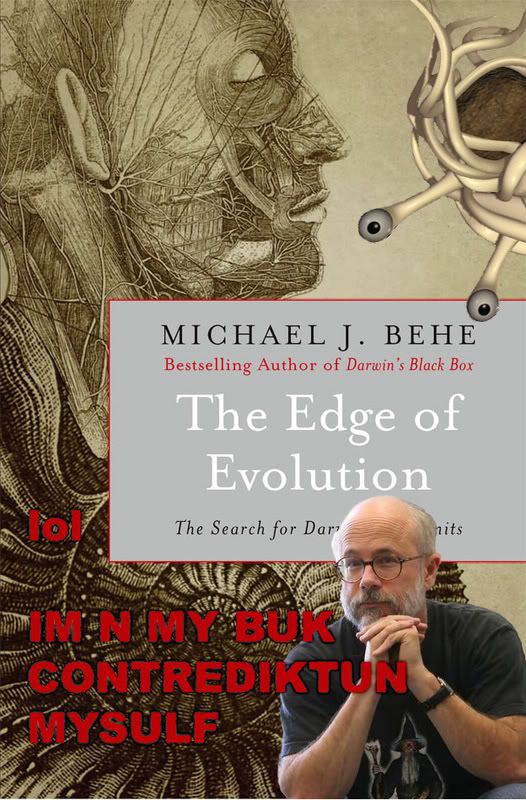
The Edge of Evolution

UPDATE (31 May 2007): For more on this topic, see Mark Chu-Carroll’s review, my follow-up and this list of reviews.

Yet more fallout from Time Magazine’s lamentable choice to have a fraud write their profile of Richard Dawkins:

Michael Behe’s mealy-mouthed description of Dawkins offers an interesting tidbit of news: he’s got a new book in the pipeline. Called The Edge of Evolution: The Search for the Limits of Darwinism, and due out this June, it promises a level of dreck not seen since Darwin’s Black Box (1997).

I have little doubt that the pro-fact sector of the Blagopelago will drown The Edge of Evolution in scalding, scathing, witty and above all factually correct reviews. To get the process started, I’d like to look at the laudatory quotes which currently praise this book which is almost certain to be a waste of paper.
Continue reading The Edge of Evolution

Time: You’re On Notice!

In its quest to avoid irrelevance, Time Magazine has boldly surged into idiocy.

Remember a while back when this magazine-of-former-repute told us that “You” were the person of the year? As it happens, one of the Blagnet’s pixel-stained wretches predicted their choice over two months in advance, suggesting that no, we don’t need magazines to spout this kind of vanity — amateurs will do just as good a job for free.

A pragmatic person, given the job of managing a wood-pulp publication in these wild days of Web 3.1, would direct that publication’s efforts into doing things which the amateurs cannot. For example, they could send reporters to far-off locales, pull their strings to get inside connections, invest serious money in fact-checking and so forth. Alternatively, they could decide to outdo the Blagopelago through sheer force of idiocy. It’s not easy, but it could in theory be done.

Today, that theory has received empirical support.

Richard Dawkins is number 73 on the Time 100, and guess who they paid to write his profile.
Continue reading Time: You’re On Notice!

Call for Papers

I find it both interesting and heartening that several people’s first reaction to this was, in a word, “Sokal.”

High quality papers for the International Journal for Creation Research (IJCR), sponsored by the Institute for Creation Research, are now invited for submission. IJCR is a professional peer-reviewed online technical journal hosted by the ICR website for the publication of interdisciplinary scientific research from the perspective of a recent Creation and a global Flood within a biblical framework.

If this were the Discovery Institute, I’d say you should go for some blather about reverse engineering and Shannon information. Unfortunately, ICR wants Young-Earth papers:

Papers should be up to 10,000 words long, and color diagrams, figures and photographs are encouraged. Papers can be in any scientific, or social scientific, field, but must be from a young-earth perspective and aim to assist the development of the Creation Model of Origins. Papers should be submitted in a plain text, single line-spaced Word or RTF file. Formatting should be kept to an absolute minimum. Do NOT embed graphics, tables, figures or photographs in the text, but supply them in separate files, along with captions.

Naturally, the minions of darkness use Word. It was there in the beginning, don’cha know? I reproduce the following paragraph merely to include their e-mail address and increase their likelihood of being spammed:

Papers should be emailed as attached files to the IJCR Editor-in-Chief at aasnelling@ozemail.com.au, and other requirements followed as per the Author Checklist in the Instructions to Authors Manual. We aim to publish submitted papers within six (6) months of receipt.

Question: given the known distaste young-Earthers have for Intelligent Design advocates, would theobabble about “complexity” meet their standards? I’m genuinely curious. Are they more likely to accept anything which supports their cause, or to reject it because it sounds too much like those Old Earth science-appeasers?

Seriously, Now

Dear Internet:

There was a fourth Teenage Mutant Ninja Turtles movie? It came out a month ago? And I never heard?

Seriously, Internet, you’re letting me down.

Oh. They never mentioned it on ScienceBlogs — that would explain a few things.

Not only do I feel betrayed by the Blagnet, but I also feel like I missed what could have been a deeply personal experience with resonances of happy times in my past. Back in high school, my friends all dressed up as the Turtles for Senior Ambition Day. I could have had some serious, only partially ironic enjoyment.

Curse you, perfidious Network!

Foxworthy

James Barlow asked a good question down in the comments, which I thought was worth promoting to the top level.

Anyone got any ideas for completing this Foxworthy-esque statement:

You’re probably shilling for the Discovery Institute if. . .

Some suggestions:

  • You say the words “specified complexity” with a straight face.
  • You believe that a “Darwinist conspiracy” is keeping Intelligent Design out of the peer-reviewed journals.
  • Every claim you make has already been dissected at Talk Origins.

Further completions welcome!

Mitsubishi Punctuated Equilibrium

Anybody drive a Mitsubishi Lancer Evolution? If so, you’re aiding and abetting the forces of Satan, as Arnold Zwicky patiently explains:

The Lancer Evolution is, according to the Wikipedia page, “Mitsubishi’s flagship sports car”, in production since 1992 and now up to 2007 model X (that’s a Roman numeral, not an unknown quantity). The name “Evolution” was probably chosen to suggest progress, but it occurred to Swarthmore biologist Colin Purrington a little while back to wonder whether the name might be a drawback in parts of the U.S. where creationist, rather than Darwinian evolutionist, ideas have considerable currency — places where, you might say, “evolution” is a dirty word. Being a scientist, Purrington collected some data (from Mitsubishi) and assembled a nifty graph, headed “‘Evolution’ car dissed by Red States”:

Colin Purrington: Evolution units per million citizens

According to its Flickr page, Purrington has released this graph under the Creative Commons BY-NC-SA 2.0 license. He comments:

The quote is from the official marketing web site. There are no plans to release a “Lancer Creation” version, as far as I know. Las Vegas is probably driving the odd sales data for Nevada (it was a filming location for the Evolution-featurin’ flick, “Too Fast Too Furious”, I think). Not sure what is up for Maine. I probably need to rerun the statistics using “18-44 males” to get a more accurate estimate of the underlying car-buying population that favors Rally and NASCAR models. And, to be fair, I should include a control car (e.g., Galant) from Mitsubishi, just in case the red states have a tendency of “buying American”, which probably plays a part in these data.

Zwicky corrects, “Ah, not “2 Fast 2 Furious” (2003), which was set in Miami and filmed in various Floridian locations, but “Redline” (2007); both movies destroyed a lot of cars and were not well received by critics, so it would be easy to confuse them.” One should probably also run a comparison to control for general economic well-being, which I’m sure affects car-buying habits. According to the manufacturer’s horrendously Flash-drenched wobsite, the 2006 Lancer Evolution will dent your wallet to a depth varying from $29,774 (“Rally Special” trim) to $36,924 (“the ultimate”). Comparing to other cars, foreign and domestic, in the same price range would be necessary in order to lock down all the variables.

Still, it’s a funny graph.

And when you’re tooling out in your MR Lancer Evolution to pick up your sultry atheist babe, be sure to give her a bottle of DNA perfume, in its spunky triple-helix bottle officially approved by the Ig Nobel Prize Committee.

IN OTHER NEWS: John Armstrong, whose taste in music is quite respectable, has said positive things about William Shatner. Cue the Four Horsemen and the Seven Seals.