Liveblagging: Geoffrey West

I’m sitting in MIT’s lecture hall 34-101, where a Venerable Personage is introducing today’s physics colloquium speaker, Geoffrey West (Santa Fe Institute). Like most colloquium speakers (or so it seems to me) West has a string of academic honors to his name; perhaps more unusual is his membership in Time magazine’s “100 most influential people” list, for which he was profiled by Murray Gell-Mann. (At that, he had more luck than Richard Dawkins.) West’s talk will concern scaling laws in living systems, and its abstract is as follows:

Life is very likely the most complex phenomenon in the Universe manifesting an extraordinary diversity of form and function over an enormous range. Yet, many of its most fundamental and complex phenomena scale with size in a surprisingly simple fashion. For example, metabolic rate scales as the 3/4-power of mass over 27 orders of magnitude from complex molecules up to the largest multicellular organisms. Similarly, time-scales, such as lifespans and growth-rates, increase with exponents which are typically simple powers of 1/4. It will be shown how these “universal” 1/4 power scaling laws follow from fundamental properties of the networks that sustain life, leading to a general quantitative, predictive theory that captures the essential features of many diverse biological systems. Examples will include animal and plant vascular systems, growth, cancer, aging and mortality, sleep, DNA nucleotide substitution rates. These ideas will be extended to social organisations: to what extent are these an extension of biology? Is a city, for example, “just” a very large organism? Analogous scaling laws reflecting underlying social network structure point to general principles of organization common to all cities, but, counter to biological systems, the pace of social life systematically increases with size. This has dramatic implications for growth, development and sustainability: innovation and wealth creation that fuel social systems, if left unchecked, potentially sow the seeds for their inevitable collapse.

Now, let’s see if I can keep up!

SCALING BEHAVIOR

“I think it’s patently obvious that I’m not one of the hundred most influential people in the world,” West says, “which should be obvious after I’ve finished my talk.” There follows an amount of fumbling as West and the distinguished personage try to turn on the overhead projector — “We need an experimentalist!” — before the big red button is found, and the projector screen glows into life.
Continue reading Liveblagging: Geoffrey West

Wilson on Wikipedia

Geologist Mark Wilson has an interesting opinion piece at Inside Higher Ed,Professors Should Embrace Wikipedia.” While it was published on April Fool’s Day, one can take it in full seriousness. I don’t agree with it fully, but I believe the points it raises are well worth discussing. Here’s the nub of his argument:

What Wikipedia too often lacks is academic authority, or at least the perception of it. Most of its thousands of editors are anonymous, sometimes known only by an IP address or a cryptic username. Every article has a “talk” page for discussions of content, bias, and organization. “Revert” wars can rage out of control as one faction battles another over a few words in an article. Sometimes administrators have to step in and lock a page down until tempers cool and the main protagonists lose interest. The very anonymity of the editors is often the source of the problem: how do we know who has an authoritative grasp of the topic?

That is what academics do best. We can quickly sort out scholarly authority into complex hierarchies with a quick glance at a vita and a sniff at a publication list. We make many mistakes doing this, of course, but at least our debates are supported with citations and a modicum of civility because we are identifiable and we have our reputations to maintain and friends to keep. Maybe this academic culture can be added to the Wild West of Wikipedia to make it more useful for everyone?

And here’s his proposal for action:

I propose that all academics with research specialties, no matter how arcane (and nothing is too obscure for Wikipedia), enroll as identifiable editors of Wikipedia. We then watch over a few wikipages of our choosing, adding to them when appropriate, stepping in to resolve disputes when we know something useful. We can add new articles on topics which should be covered, and argue that others should be removed or combined. This is not to displace anonymous editors, many of whom possess vast amounts of valuable information and innovative ideas, but to add our authority and hard-won knowledge to this growing universal library.

An old saying has it that of all kinds of politics, academic is the nastiest, because the stakes are the lowest. One might fret that legions of quarrelsome professors would trample all over the pages pertaining to the controversies in their own specialized fields, bringing all the fury of the Dawkins/Gould or Fodor/Dennett deathmatches to the world of Wikipedia. However, I know of no evidence suggesting that these arguments would really be any more vituperative than the ones which already occur. Furthermore, Wikipedians with advanced degrees already exist; Wilson’s proposal would only bring in a larger number of them, perhaps with a shared ethos or sense of common purpose.
Continue reading Wilson on Wikipedia

Milestone of Dubious Merit

Since I started Science After Sunclipse a year and odd days ago, it has received 30,003 spam messages. On the 572 posts currently hosted here, 2,013 legitimate comments have been left (including replies I’ve made to others). So, just about one in every fifteen comments have been “ham” instead of spam.

Thirty kilospams. . . I feel like I should throw a party.

News from the Google Hit Parade

BPSDBCuttlefish was feeling upset that a piece of creationist drivel was ranking higher in the Google search results for the word “cuttlefish” than his own site, so in a gesture of amity, I’m doing my bit to help. Restore justice, truth and verse to the Network: link to Cuttlefish today!

And while we’re thinking about search results, Googling for {expelled movie} is finally bringing up some sensible results for Ben Stein’s monument to dishonesty, hatred and incompetence, Expelled: No Intelligence Allowed. One instance of the trailer sends the reader to Richard Dawkins’s website, which is a promising start. Then we’ve got a Digg entry for Phil Plait’s demolition of Expelled, and a fairly old post — last September — from the Bad Idea Blog, pointing out the dishonesty of Expelled‘s producer.

The “sponsored links” over on the side gives me RationalWiki’s debunking of Expelled promo material. That’s also good. Notice, however, what’s missing?

Expelled the movie -- Exposed!The official site of the National Center for Science Education, devoted to debunking the movie — Expelled Exposed — doesn’t appear in the first one hundred results. In fact, as of right now, it doesn’t appear until result 280.

We need to fix this.

We’re trusting the NCSE with the big responsibility of maintaining a clear and informative central site for this subject. I think they’re up for it; I also think, gosh darn it, they need to know we care.

An Unusual Occurrence

So there I was, quietly standing in Lobby 10, queuing to buy myself and a few friends advance tickets to Neil Gaiman’s forthcoming speech at MIT, when a strange odor proturbed onto my awareness. “That’s odd,” thought I, “it smells like backstage at my high school’s auditorium. [snif snif] Or the bathroom at Quiz Bowl state finals. . . And it’s not even 4:20. Something very unusual is going on, here on this university campus.”

I became aware of a, well, perhaps a presence would be the best way to describe it: the sort of feeling which people report when their temporal and parietal lobes are stimulated by magnetic fields. Something tall and imposing was standing. . . just. . . over. . . my. . . right. . . shoulder! But when I turned to see, I saw nothing there.

Feeling a little perturbed, I bought my tickets and tried to shrug it off. Not wanting to deal with the wet and yucky weather currently sticking down upon Cambridge, I descended the nearest staircase and began to work my way eastward through MIT’s tunnel system, progressing through the “zeroth floors” of the classroom and laboratory buildings, heading for Kendall Square and the T station. Putting my unusual experience in the ticket queue out of my mind, I returned to contemplating the junction of physics and neuroscience:

“So, based on the power-law behavior of cortical avalanches, we’d guess that the cortex is positioned at a phase transition, a critical point between, well, let’s call them quiescence and epileptic madness. This would allow the cortex to sustain a wide variety of functional patterns. . . but at a critical point, the Wilson-Cowan equations should yield a conformal field theory in two spatial dimensions. . . .

“But if you reinterpret the classical partition function as a quantum path integral, a field theory in 2D becomes a quantum field theory in one spatial and one temporal dimension. And the central charge of the quantum conformal field theory is equal to the normalized entropy density. . . so we should be able to apply gauge/gravity duality and model the cortex as a black hole in anti-de Sitter spacetime —”

Suddenly, a tentacle wrapped around my chest, and constricted, and pulled, and lifted — not up, but in a direction I had never moved before. Like a square knocked out of Flatland, I had been displaced.
Continue reading An Unusual Occurrence

Transhuman Science Begins Today?

A while back, we noted an interesting exchange which Neil Shubin had with Stephen Colbert on The Colbert Report.

COLBERT: If I used to be a fish, and then I was a monkey, and now I’m a man, then what’ll be next?

SHUBIN: That’s a good question, ’cause we humans are actually now controlling our own evolution. So, if you’re worried about steroids in baseball now, come back in twenty-five years, because our technologies are fundamentally going to change our bodies. It’s gonna change how we work; medications are going to change how our bodies actually function and so forth. So really I think if you come back, we’re going to be sort of a product of technology and biology.

COLBERT: So you’re saying we’re wresting the steering wheel away from Darwin?

SHUBIN: I’m afraid with our ability to generate new technologies, essentially we are.

COLBERT: Can we turn ourselves back into fish? ‘Cause I’d love to be a shark.

These things have a way of becoming relevant sooner than we’d think. Bora Zivkovic and Jonathan Eisen report on an interesting and, for some, disturbing development from the National Institutes of Health:
Continue reading Transhuman Science Begins Today?

Enchantment

Ursula K. Le Guin’s review of Salman Rushdie’s The Enchantress of Florence (2008) has, at least, convinced me to read a whole stack of Ursula K. Le Guin. I mean, how could I resist an author who says this?

Some boast that science has ousted the incomprehensible; others cry that science has driven magic out of the world and plead for “re-enchantment”. But it’s clear that Charles Darwin lived in as wondrous a world, as full of discoveries, amazements and profound mysteries, as that of any fantasist. The people who disenchant the world are not the scientists, but those who see it as meaningless in itself, a machine operated by a deity. Science and literary fantasy would seem to be intellectually incompatible, yet both describe the world; the imagination functions actively in both modes, seeking meaning, and wins intellectual consent through strict attention to detail and coherence of thought, whether one is describing a beetle or an enchantress. Religion, which prescribes and proscribes, is irreconcilable with both of them, and since it demands belief, must shun their common ground, imagination. So the true believer must condemn both Darwin and Rushdie as “disobedient, irreverent, iconoclastic” dissidents from revealed truth.

Movie vs. Trailer Deathmatch: 21

Last fall, I helped write and a spoof rock musical called 22. It was a pun-heavy tour of the MIT campus whose “plot,” such as it was, circled around a terrorist threat involving an Infinite Improbability Generator. The title was a sly reference to 24, you see; however, were we to do the same thing today, the same title would let us mock the blackjack movie 21. Here’s the trailer for the movie — extremely loosely based on the antics of a few MIT students — a trailer which I happened to see back in January, at the Science Fiction Marathon:

I could crack a few obvious jokes — I mean, isn’t “Break on Through (To the Other Side)” basically as overplayed as “Bad to the Bone,” and couldn’t we at least get, I dunno, “Love Spreads” by the Stone Roses? More entertaining, perhaps, is the reaction of the MIT News Office, which says of Kevin Spacey’s character, “While his irresponsible acts may enliven the Hollywood script, they are entirely unrepresentative of the Institute.”

Better still, Christopher Orr has reviewed the movie based solely on the trailer above, plus the Internet Movie Database’s list of character names:
Continue reading Movie vs. Trailer Deathmatch: 21

Top 3 Conference Proceedings

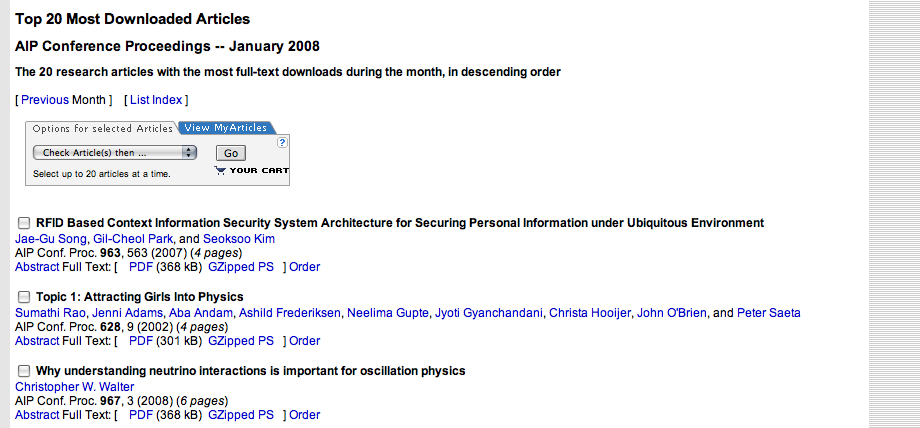
At this moment, these are the most downloaded conference proceedings from the American Institute of Physics:

Top Downloads (click to embiggen)

If you’re too lazy to click and embiggen, the second item is S. Rao et al.,Topic 1: Attracting Girls Into Physics” AIP Conf. Proc. 628, 9 (2002).

The third item is Chris Walter’s “Why understanding neutrino interactions is important for oscillation physics” (on the arXiv here). I worked in Chris Walter’s research group a couple summers ago; he’s a cool guy.

Connections, Episode 10

This is the sort of thing which tends to get taken off the Network once the Powers Which Be notice that it exists, so we should enjoy it now. Here and there, in chunks of different sizes, we can find James Burke’s original Connections (1978) TV series. Embedded on this page is the tenth and last episode, “Yesterday, Tomorrow and You.” I could say many things about it, but for now, I’ll just note that “network robustness” has become a subject of quantitative investigation, that I can’t escape the feeling the arguments which perennially perturb the science-blogging orbit still aren’t addressing the points which Burke raised thirty years ago, and that you can’t go wrong with Ominous Latin Chanting.


Continue reading Connections, Episode 10

"no matter how gifted, you alone cannot change the world"