Yawn: More Abuse of the Quantum

Binocular rivalry is a phenomenon which occurs when conflicting information is presented to each of our two eyes, and the brain has to cope with the contradiction. Instead of seeing a superimposition or “average” of the two, our perceptual machinery entertains both possibilities in turn, randomly flickering from one to the other. This presents an interesting way to stress-test our visual system and see how vision works. Unfortunately, talk of “perception” leads to talk of “consciousness,” and once “consciousness” has been raised, an invocation of quantum mechanics can’t be too far behind.

I’m late to join the critical party surrounding E. Manousakis’ paper, “Quantum theory, consciousness and temporal perception: Binocular rivalry,” recently uploaded to the arXiv and noticed by Mo at Neurophilosophy. Manousakis applies “quantum theory” (there’s a reason for those scare quotes) to the problem of binocular rivalry and from this hat pulls a grandiose claim that quantum physics is relevant for human consciousness.

A NOTE ON WIRES AND SLINKYS

First, we observe that there is a healthy literature on this phenomenon, work done by computational neuroscience people who aren’t invoking quantum mechanics in their explanations.

Second, one must carefully distinguish a model of a phenomenon which actually uses quantum physics from a model in which certain mathematical tools are applicable. Linear algebra is a mathematical tool used in quantum physics, but describing a system with linear algebra does not make it quantum-mechanical. Long division and the extraction of square roots can also appear in the solution of a quantum problem, but this does not make dividing 420 lollipops among 25 children a correlate of quantum physics.

Just because the same equation applies doesn’t mean the same physics is at work. An electrical circuit containing a capacitor, an inductor and a resistor obeys the same differential equation as a mass on a spring: capacitance corresponds to “springiness,” inductance to inertia and resistance to friction. This does not mean that an electrical circuit is the same thing as a rock glued to a slinky.

MIXING THE QUANTUM AND THE CLASSICAL

One interesting thing about this paper is that the hypothesis is really only half quantum, at best. In fact, three of the four numbers fed into Manousakis’ hypothesis pertain to a classical phenomenon, and here’s why:

Manousakis invokes the formalism of the quantum two-state system, saying that the perception of (say) the image seen by the left eye is one state and that from the right eye is the other. The upshot of this is that the probability of seeing the illusion one way — say, the left-eye version — oscillates over time as

[tex]P(t) = \cos^2(\omega t),[/tex]

where [tex]\omega[/tex] is some characteristic frequency of the perceptual machinery. The oscillation is always going, swaying back and forth, but every once in a while, it gets “observed,” which forces the brain into either the clockwise or the counter-clockwise state, from which the oscillation starts again.

The quantum two-state system just provides an oscillating probability of favoring one perception, one which goes as the square of [tex]\cos(\omega t)[/tex]. Three of the four parameters fed into the Monte Carlo simulation actually pertain to how often this two-state system is “observed” and “collapsed”. These parameters describe a completely classical pulse train — click, click, click, pause, click click click click, etc.

What’s more, the classical part is the higher-level one, the one which intrudes on the low-level processing. Crudely speaking, it’s like saying there’s a quantum two-state system back in the visual cortex, but all the processing up in the prefrontal lobes is purely classical.
Continue reading Yawn: More Abuse of the Quantum

Rejecta Mathematica

Walt and Isabel are talking about the newest oddity in mathematics publishing: a forthcoming journal called Rejecta Mathematica. This will be an online journal dedicated to mathematical papers which have been rejected from peer-reviewed publications.

Such a journal could be a useful publication venue: papers which show that a promising technique fails or which reprove a known theorem in a not-quite-snazzy way might be worth collecting. Furthermore, it would be neat to look at a probability argument or some “entropy” bafflegab from a cdesign proponentsist and say, “This couldn’t even be published in Rejecta!

Cuttlefish Wins Teh Internets

To those familiar with the Cuttlefish‘s habits, this is, of course, old news.

I wouldn’t think you could get anything useful out of a blogospheric ramble about Blavatsky and Theosophy, but the Digital Cuttlefish was able to see past the blather about “fifth race humans” and the “girasas race” to find artistic and comedic gold, with just the proper bite:

Ceiling Cat is watching you post
From up in his lofty location —
The comments make Ceiling Cat shudder and say
“O Hai. You can has medication.”

(Image from the Lolcat Bible.)

Vacation Memories 2: Baggage

I’m back home from my brief travels, and I returned to find the latest outbreak of quantum woo infection, followed immediately by a heap of silliness about anthropic twaddle.

“Too soon,” I thought. “I need to go back on vacation.”

So, instead of complaining at great length about things I’ve already complained about, I’ll just share one quick observation and then head out into the outside world, shopping for art supplies.

Yesterday, I flew into Boston. In my laptop I carried a hardback of Lois Lowry‘s The Giver (1993) and, to recapture a more innocent time, Feynman and Weinberg’s Elementary Particles and the Laws of Physics (1987). In between reading these two, I happened to glance at the pamphlet-type thing which the airline clerk had given me to hold my boarding passes in. Here’s the puzzling part, under the “Free Baggage Allowance” heading:

Carry-on Baggage is limited to one piece per passenger, plus a personal item such as a purse, briefcase or laptop computer. The carry-on cannot exceed 51 inches (11″ × 14″ × 26″) and must fit under the seat or in an overhead compartment.

Why are the three linear dimensions added? The frame device the airline positions at each gate for testing whether or not your carry-on will fit rejects your baggage if any dimension exceeds the threshold set. Your baggage is deemed invalid even if the total volume is less than 11″ × 14″ × 26″ = 4004 in3 (just try carrying on something long and skinny). The longest diagonal of an 11″ × 14″ × 26″ box is

[tex]\sqrt{14^2 + 26^2} \approx 29.5[/tex]

inches long. So, you can have a carry-on item the sum of whose edge lengths is, say, thirty-one inches, and which won’t fit the actual airline restrictions no matter how you try to wedge it in sideways. The sum of the height, width and depth is a meaningless number.

Vacation Memories 1: Unbuilding

One of the fringe benefits of visiting family is that I get to reacquaint myself with the books among which I grew up. Prominent among my warm and sunlit memories of bookworm-hood are David Macaulay‘s illustrated volumes. Macaulay’s career began with Cathedral (1973), the story of a medieval town building a Gothic cathedral; he followed with Pyramid (1975) and Castle (1977), among others, and his whimsy grew to (heh heh) mammoth proportions with The Way Things Work (1988).

The book I’d like to talk about today, however, is Unbuilding (1980). After describing how all sorts of great architectural works were built, Macaulay decided to explain how one gets taken apart, and for his example, he chose the Empire State Building. The whole book is full of fascinating details on how a building can be demolished, with some portions preserved for re-erection elsewhere, but those details aren’t what caught my eye. In each of his illustrated architecture books, Macaulay provides a back story, telling who’s building the title piece of the book and why. Naturally, he constructs a story for the Empire State Building’s demolition, too.

Prince Ali Smith, a Saudi oil tycoon educated in the United States, needs a new corporate headquarters for the Greater Riyadh Institute of Petroleum (GRIP). To the surprise and bafflement of his fellow executives, Prince Ali announces that GRIP will buy the Empire State Building, dismantle it, and rebuild it in the Arabian desert. What happens next, I quote below the fold:
Continue reading Vacation Memories 1: Unbuilding

Glum in the Bookstore

Over at the Hellfire Club, Russell Blackford has been writing 15,000 words on American science fiction for a big zarkin’ literary encyclopedia. Part of his job seems to be the invention of history: he gets to write about “contemporary” science fiction, the writing on which judgments have not yet been made. And while talking about books is always fun, saying things which have never been said before about them is even better.

(Yo, transhumanists: is there any market which will pay me to discourse on how the practice of “tubing” fetuses in the Honorverse, and particularly in the novel At All Costs (2005), is the science-fictional antithesis of Brave New World (1932)? )

Anyway, having this freshly in mind put me into a bit of a melancholy mood last night, while I was wandering through the local Barnes-and-Borders-A-Million. (I’m visiting family in a town where there’s not much else to do.) From the looks of their science-fiction section, the surest way to get published is to write a Star Wars or Star Trek novel. To paraphrase Mr. Spock, that’s a situation which calls for a colorful metaphor. I mean, do we really want the New Jedi Order to be the public face of contemporary SF?

Squidtivity

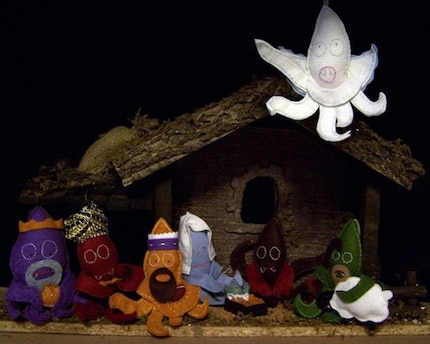
A famous example of the troubles involved in Biblical translation is the expression “lamb of God.” How do you convey the idea — the cute animal which gets killed to sate bloodlust — to a culture which doesn’t know about lambs? If you were trying to translate the New Testament for the Inuit, to cash in on the lucrative Nunavut market, you might go with “seal of God” instead.

I don’t think anybody has yet gone with “squid of God,” however. So, to provide at least a partial remedy, I give you Squidtivity!

I wonder why Sunday school forgot to mention that the wise men came from R’lyeh.

Tip o’ the Magi’s crown to Retrokatze.

Blake Says

One night, at a party deep into a Boston winter, a young woman heard my name and asked me if I was the one “that Dresden Dolls song” was about. She was beautiful, so I said yes.

The song, so it happens, has been rather hard to come by.

Off for the Weekend

Today and tomorrow, I’m going to be busy in a part of the world with spotty Internet access, and on Monday, I’m going to be traveling. Expect any responses I make to be slow in coming.

I have some substantial stuff in the drafts pile, though, which I hope to get out on the Network early next week.

Paid to Lack a Sense of Humor

The Associated Press has an article on the wire about “leading religious scholars” discussing the Flying Spaghetti Monster. And in other news, the American Physical Society has decided to pay me to write about YouTube videos!

No, not really, but that’s about how silly this looks. I mean, you can get money for standing in front of a room o’ greybeards and showing them this picture?

The story itself is surprisingly sympathetic to the rationalist cause:
Continue reading Paid to Lack a Sense of Humor

Pay No Attention to the Man

Dave Bacon mentions a possible instance of NSA chicanery, which reminds me of a story. First, I should relate a little background:

At MIT, each undergraduate has a few different “advisers” during their stay. You have a “freshman adviser” during your first year; after you declare a major, you get an adviser within your department who basically signs paperwork for you once or twice a term. If you survive a few years at the Institute, you’ll also work with a “thesis adviser,” who probably won’t be the same person as your departmental adviser. This story concerns my paperwork-signing adviser, Edward Farhi. Since Krishna Rajagopal told our entire quantum class about this incident, I figure it’s OK to repeat the tale here.

Prof. Farhi works in quantum computation, it so happens, and in the course of this work, he had cause to use some pretty hefty computer power. The details don’t matter so much, but doing the simulations he had to do required so many computrons that eventually his research hit a bottleneck.

This was the situation when he gave a presentation to a roomful of funding-agency representatives, describing his research. After his talk, a man from the NSA approached him and said, “That is very interesting work you do.”

Farhi replied, “Thank you. Of course, as I mentioned, we’re stalled at the moment, since we’ve gone as far as we can go with the computers we have. If we could use your computers. . .”

[This is where Rajagopal interpolated, “Eddie is pretty gutsy.”]

The man from the NSA stared blankly at him. “I can neither confirm nor deny,” he said, “that the National Security Agency has computers.”

"no matter how gifted, you alone cannot change the world"