A Not-Schrödinger Joke?

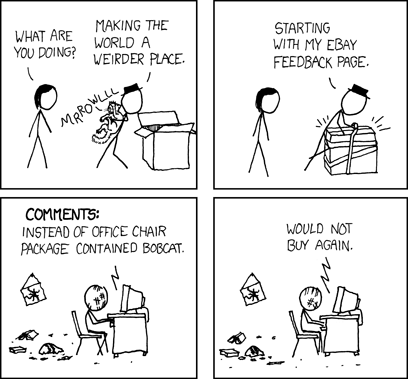
Today’s xkcd puzzles me.

It’s a cat in a box, but it’s not a Schrödinger joke? Dood! UR IN MY HEAD, MESSIN WIT MAH MEEMZ. And, judging by the comments, I’m not the only one to be suffering in perplexity this morning.

Let’s just say that if I were expecting an office chair and opened the box to discover a live Schrödinger bobcat, my hopes would collapse, and my ensuing comments would be rather decoherent.

Philosophia Naturalis #14

While I continue to befuddle myself with my random-spatial-network simulation results, everyone else should go enjoy themselves by reading Philosophia Naturalis #14, the latest edition of the physical-science blogging carnival. It’s got a Sputnik theme!

And, why not, here’s Tom Lehrer singing about “Pollution.”

Back to my perplexing plots I go. . . I need to wrap things up in time to attend the Ig Nobel Prizes tonight.

Scott Aaronson’s Outreach Program

What’s that sound? Could it be the information content of the popular discourse about quantum physics rising by a detectable degree?

Oh, dear. An advertising agency took a passage from Scott Aaronson’s quantum computing lecture notes and used it in a commercial.

Model 1: But if quantum mechanics isn’t physics in the usual sense — if it’s not about matter, or energy, or waves — then what is it about?

Model 2: Well, from my perspective, it’s about information, probabilities, and observables, and how they relate to each other.

Model 1: That’s interesting!

Naturally, the commercial doesn’t mention where they got the text from, but thanks to the quintessential Internet appeal of this story, it looks like Prof. Aaronson is already getting some server-crashing free publicity out of this. Should he be demanding more? Like, say, private tutoring sessions with the fashion models who show such an interest in quantum theory? Each of them have already shown a far greater command of the material than, for example, Deepak Chopra, and it would be a shame to waste such an opportunity.

You can read the ad agency’s craven response in this Sydney Morning Herald article:
Continue reading Scott Aaronson’s Outreach Program

Spectre upon Science

Argh. Somehow I’ve become the rewrite guy for a paper on modeling the United States healthcare system. Big chunks of the material we have so far is a direct transcript from somebody’s talk, so it has to be thoroughly revamped. Also, the people we’re writing it for have apparently forgotten everything junior high school taught them about logarithms, which makes explaining why a power-law distribution looks like a straight line on a log-log plot rather, well, interesting. I’ve been told to exile all actual equations to the sidebar. While I get on with my head-impact-wall moment, here’s something I found on my hard drive. I promise some juicy and weird stuff about statistical physics and neuroscience, once I regain my esteem for humanity.

SPECTRE UPON SCIENCE: A VIGNETTE

“These are dark times, my fellow Americans.

“Do you know what is happening across this country? Dawn is sweeping from one coast to the other, mothers are rousing their children from bed, and children are walking and bicycling to school, where they are being taught how to lie with statistics. In math class, little Johnny is learning how the axes of a graph can be distorted, the dangers of selection bias and that correlation is not causation. He and Mary go to English class, where they’re trained in today’s tool from the ‘baloney detection kit‘. They learn that ‘All the aggressor’s attempts to advance beyond Baghdad have failed‘ is a cover for the loss of Baghdad. I’ve just received poll results showing that for the first time, seventy-two percent of Americans know that electrons are smaller than atoms, seventy-eight percent believe that human beings evolved from a common ancestor shared with apes, and ninety-two percent know that the Earth travels around the Sun! These figures shock us all, I know, but they are only the most visible edge of a phenomenon which threatens the continued existence of our organization.
Continue reading Spectre upon Science

Parties of Past and Future

Joel Achenbach speculates about the possibility of having an “18th Century Weekend.” Disavow all knowledge of portable music players, television sets, automobiles (hybrid or otherwise) and the wireless telegraph, and return the neighborhood to the days when Western Civilization first tried out the Enlightenment. Syphilis and smallpox are optional.

But in reality we’re not trying to recreate the past, much of which was, let us state clearly, a grinding horror. This is not a costume party. [Nor are we trying to create our own little Earthaven, though being more energy conscious would be a good outcome.] [Nor would this be like living in the pre-luxury-hotel version of Biosphere 2.] We’re just trying to find ways to connect, be a bit more local, and neighborly, and maybe have more face-to-face conversations, and get a little exercise walking to the coffee shop rather than burning gasoline.

Of course, perhaps the 18th Century is a bit too far away:

Simply turning the clock back to 1990 — and quitting email for a couple of days — would be liberating and revelatory. Maybe it should just be 1980s weekend, performed to the soundtrack of Madonna, Michael Jackson and Duran Duran.

Quitting email?! Say wha?

Actually, I prefer to make every weekend “Not-So-Distant-Future Weekend.” I read the news on my portable Universal Computation Device, and every time I meet a revolving door, I pretend that it’s really an airlock.

Liberman on Uriagereka and FOXP2

Having aired my grievances about New Scientist (here, here and here), about Wired (here and over here) and about Time (yup, here), I was wondering when I’d get a chance to complain about Seed. This morning, Mark Liberman provides the necessary gripe-fodder, poking a big, sharp stick at Juan Uriagereka’s “The Evolution of Language” (25 September 2007).

Unlike much of the science writing that gets a blogospheric assault, today’s target involves a researcher stepping off into sheer speculation, rather than a journalist oversimplifying or seeking a false “balance.”

According to Liberman, Uriagereka “combines some important themes with what seem to me to be some bizarre fantasies.” Specifically, Liberman takes issue with the assertion that finches must have the same neural “parser” as humans do; while transmitting and receiving birdsong may well have general principles in common with transmitting and receiving human language, saying that the two must rely upon the same “parser” is going a measure too far.

Furthermore, Liberman says,
Continue reading Liberman on Uriagereka and FOXP2

Beyond Vulgar Moral Relativism

After you’ve gotten your chuckles and inspiration from Revere’s Freethinker Sunday Sermonette, check out Russell Blackford’s most recent post on moral scepticism. A sample:

The plausible meta-ethical positions seem to be a group of sophisticated moral relativist theories — the sort of position I associate with Gilbert Harman, David Wong, Neil Levy, Max Hocutt, and others — and the error theories (moral scepticism) of people like JL Mackie, Richard Garner, Richard Joyce, and Joshua Greene. There are various other positions in the same ballpark, such as the sophisticated non-cognitivism of Simon Blackburn. I am sometimes irritated when other philosophers assume that the only theory in this sort of ballpark is the popular but vulgar kind of moral relativism that we are all taught to avoid in first-year ethics courses.

Numbers like $50 Billion

Isabel reminds me to look at The Onion. Lo and behold, scientists are asking Congress to fund a $50 billion science thing! Apparently, the machine in question is both large and expensive, and it uses gamma rays.

“While expense is something to consider, I think it’s very important that we have this kind of scientific apparatus, because, in the end, I have always said that science is more important than it is unimportant,” Committee chairman Rep. Bart Gordon (D-TN) said. “And it’s essential we stay ahead of China, Japan, and Germany in science. We are ahead in space, with the NASA rockets going to other planets, so we should be ahead in science too.”

Unfortunately, all was not rosy on Capitol Hill:

“These scientists could trim $10 million if they would just cut out some of the purple and blue spheres,” said Rep. Roscoe Bartlett (R-MD), explaining that he understood the need for an abundance of reds and greens. “With all of those molecules and atoms going in every direction, the whole thing looks a bit unorganized, especially for science.”

Isabel makes note of something else, a thought which should linger after the chuckles fade away.
Continue reading Numbers like $50 Billion

More on New Scientist

I felt sort of bad saying all that stuff about Wired when the guy who wrote the piece I did like showed up to say “Thanks for the link.” But hey, I’m not going to stop criticizing bad science reporting, nor can I imagine shutting myself up about the practices which I think cause bad science journalism. (Nor do I have the vanity to think that by myself, I’ll make any difference.) I’d feel considerably more uncomfortable if Greg Egan didn’t go and provide a whole new plateful of reasons to be upset with pop science.

Egan has been masochistically plowing through New Scientist ever since the EmDrive incident, when he had found himself “gobsmacked by the level of scientific illiteracy” the magazine had put on display. Now, commenting at The n-Category Café, he gives two additional recent “absurdities.”
Continue reading More on New Scientist

Rock on, Rebecca!

Rebecca Watson, Skepchick extraordinaire, has won the Public Radio Talent Quest contest. She joins Al Letson and Glynn Washington in the winners’ circle; each of them will receive ten thousand dollars and the chance to produce pilot episodes for new national public radio programs.

Yes, Rebecca is the one who declined to go out for a milkshake with me because my ESP remote-viewing powers were off by two tentacles. Scandalous, really, but I bear no ill will. Instead, I offer my most heartfelt congratulations! Best of luck to all three, and here’s hoping we’ll get some quality radio.

Start Your Own (Pseudo)Science Journal Today!

Living punchline Paul Cameron has decided to start his own “peer-reviewed” journal to publish homophobic diatribes disguised as science. Titled The Empirical Journal of Same-Sex Sexual Behavior, it will soon be coming to a website near you.

You know, I find this idea rather inspirational. I wasn’t quite sure how to advance my idea that William Shakespeare wrote the plays of Christopher Marlowe (who was killed because he was a closet Copernican — “They” hushed up the incident as a fight over a bar bill) and that the truth of this assertion is encoded in the streetsigns visible in the background of Ghost in the Shell (1995). Now I know what to do: I just have to fire up a website proclaiming itself to be the Empirico-Rationalist Journal of Marlowian Conspiracy Theories.
Continue reading Start Your Own (Pseudo)Science Journal Today!

Oliver Sacks, Mountaineer

I have my reasons to dislike Wired Magazine — trendy, faux-savvy, shoddy fact-checkers that they are — but they can do a sensible interview. To wit, see this piece on Oliver Sacks, the neurologist who told us about mistaking wives for hats. Sacks tells his interviewer, Steve Silberman, a great deal about his experiences with music.

I intensely dislike any reference to supernaturalism, but I think there can be profound mystical feelings which do not have to call on fictitious agencies like angels and demons and deities. The whole natural world is bathed in wonder and beauty and mystery. The feeling of the holy, the sacred, the wonderful, the mystical, can be divorced from anything theological, and is conveyed very powerfully in music.

While many a scientist has expressed a similar sentiment, Sacks also reveals that the pleasures of the academic lifestyle were not restricted to horticulture, at least not in the 1960s.

One day in 1964, I constructed a sort of pharmacological mountain, and at its peak, I said, “I want to see indigo, now!” As if thrown by a paintbrush, a huge, trembling drop of purest indigo appeared on the wall — the color of heaven. For months after that, I kept looking for that color. It was like the lost chord.

Sacks saw the color again, after hearing Monteverdi’s Vespers at the Metropolitan Museum of Art, but the lapis lazuli snuffboxes which had appeared such a wonderful indigo turned out to be blue and mauve and pink when he looked at them again. “It took a mountain of amphetamine, mescaline, and cannabis to launch me into that space,” he says, “But Monteverdi did it too.”

Copying ISBNs Is Not a Crime

Three Harvard undergraduates were told to leave the Harvard Coop bookstore because they were copying International Standard Book Numbers from books on the shelf. The store called the Cambridge police; the officers who responded allowed the students to continue copying, and the students left of their own accord two and a half hours later.

Cops having better sense than bookstore employees. What’s the world coming to?

Revere has the details and also points to CrimsonReading.org, which looks pretty neat. Not only does it automate comparison shopping for textbooks, but it also lets you see what books Harvard requires for its courses. To be honest, I looked at their physics listings just so I could point and laugh at their effete inadequacy, but their selections actually look pretty reasonable. “Quantum Mechanics II” can’t get very far if the only book they require is Griffiths; I was expecting that an upstanding school like Harvard would at least force its students to buy Shankar, Sakurai and Cohen-Tannoudji as well. Sean Carroll will no doubt be pleased they use his book for their general relativity class.

"no matter how gifted, you alone cannot change the world"