Friday Anime Remixes

WARNING: if you have a life, you might not “get” this post.

Sometimes, the creativity of the Internet astonishes me.

No, really. I know I’m a snarky and sarcastic person given to damnation-by-faint-praise, but on occasion, even I am honestly impressed. While much of what goes on in the Network’s twisty little forking passages doesn’t contribute to saving the world, we do have to assure ourselves our world is worth saving, don’t we?

And that’s why I’m embedding the theatrical trailer for The Matrix (1999), recreated using clips from Ghost in the Shell (1995).


Continue reading Friday Anime Remixes

Where am I in the Inferno?

The Dante’s Inferno Test has banished you to the Sixth Level of Hell – The City of Dis!
Here is how you matched up against all the levels:

Level Score
Purgatory (Repenting Believers) Very Low
Level 1 – Limbo (Virtuous Non-Believers) High
Level 2 (Lustful) Moderate
Level 3 (Gluttonous) Moderate
Level 4 (Prodigal and Avaricious) Low
Level 5 (Wrathful and Gloomy) Low
Level 6 – The City of Dis (Heretics) Very High
Level 7 (Violent) Very High
Level 8- the Malebolge (Fraudulent, Malicious, Panderers) High
Level 9 – Cocytus (Treacherous) Low

Take the Dante Inferno Hell Test

Funny, I didn’t think I was that violent (and I took the non-violent option on the only questions I can think are relevant). I guess this means I won’t be joining Dave Bacon in Limbo. Lucky schmuck — he doesn’t even have to deal with the unbaptized infants anymore.

At least I won’t have to spend eternity in the tenth circle, Corpadverticus.

Quoting a Motl

Among other things, that when you talk to string theorists in person, they’re much more open-minded and reasonable than you’d expect! Of course, when your de facto spokesman is the self-parodying Luboš Motl — who often manages to excoriate feminists, climatologists, and loop quantum gravity theorists in the very same sentence — it’s hard not to seem reasonable by comparison.

— Scott Aaronson (21 December 2006)

If you inhabit the same corner of the Network that I do (and you’re reading this right now, so that seems likely) you’ve probably heard about NASA Administrator Mike Griffin’s intemperate remarks about global warming. (For a refresher, see the dependable Phil Plait.)

Via Tim Lambert, I hear that a denialist “press release” collects some approving comments from the usual suspects. Apparently, the “Science and Public Policy Institute” saved the best quote for last:
Continue reading Quoting a Motl

Fr*ming in the CJR

The framing kerfluffle has reached the Columbia Journalism Review‘s website, with a piece entitled “Just the Facts, and Opinions Too” (5 June 2007). Curtis Brainard does a pretty good job of setting out the scenario, but his story leaves out an aspect which I think is significant.

I have come to hypothesize that there are the reasonable Mooney and Nisbet, who get written up in places like Brainard’s article, and then there are their insane twin brothers who keep trying to kick those uppity atheists back into the corner. (Similar statements about rational and bizarre twins have been made for Thomas Kuhn and Lee Smolin.) To a first approximation, if I heard some people saying what Curtis Brainard records Nisbet and Mooney as saying, my response would resemble the following:
Continue reading Fr*ming in the CJR

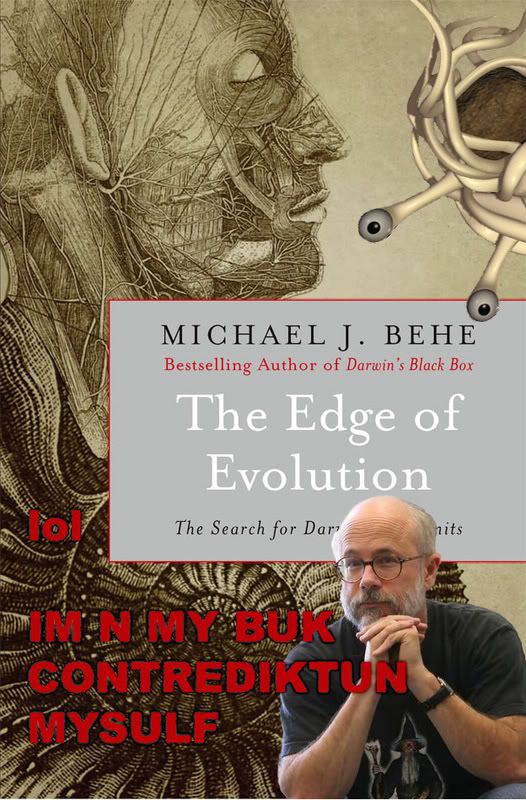
Behe’s Bad Arithmetic and Worse Science

Blogging on Peer-Reviewed ResearchI would like to celebrate the official release date of Michael Behe’s new book, The Edge of Evolution, by pointing out a grotesque factual error in its very heart.

A major theme, if not the major theme, of Behe’s diatribe is the disease known as malaria. He wants to prove that evolution by natural means of any but the most trivial features of living things is completely impossible, and he uses the parasites which cause malaria as his test case. Unfortunately for him, but happily for the decades of scientific discovery which he tries to condemn, the mistakes in his argument tear it asunder.

Since Behe’s argument is built upon malaria, and in particular the evolution of the parasite Plasmodium falciparum to be resistant to the drug chloroquine, we should look at what modern biology has learned about how chloroquine resistance evolved. As chloroquine was “the best and most affordable antimalarial drug” in the history of antimalarial drugs, the evolution of resistance to it — and the spread of that resistance throughout the world — poses a real problem, which scientists are naturally eager to investigate.
Continue reading Behe’s Bad Arithmetic and Worse Science

CEO Kills 250 Million Americans

My day job, about which I am Not Yet At Liberty To Speak in detail, brings me into contact with people I didn’t expect to meet when I graduated MIT with a physics degree. I could understand rubbing elbows with software developers, but healthcare policy professionals were a whole ‘nother world. I mean, I managed to meet and mingle with a set technician for The Truman Show, not to mention Mary Prankster. (A friend of mine spent a year in Los Angeles, driving around with a Dresden Dolls bumper sticker. One day, a guy stopped her in a parking lot and exclaimed in wonder and joy, “You like the Dresden Dolls?” To which she replied, “I know the Dresden Dolls.” She assures me that I’ve met them too, at a party somewhere in this town, but it must have been an absolutely smashing party because I have no recollection of it whatsoever.) But corporate executives?

So, it is with considerable surprise that I find myself equipped to tell the tale of the CEO who killed 250 million Americans.
Continue reading CEO Kills 250 Million Americans

Egnor, Farrell and Lemaître

I don’t want Science After Sunclipse to become, in Orac’s words, “All Egnor, all the time,” but after my recent intemperate remarks about Egnor’s misguided dualism, I figure I should follow with a link to John Farrell’s rebuttal to Egnor’s cosmology.

Following up on his insistence that science is always seeking to confirm the “design inference,” Egnor says this about Georges Lemaître, the first scientist to conceive of the Horrendous Space Kablooie:

Ironically, we owe much of our modern understanding of the universe to pro-intelligent design astronomers. Georges Lemaître was the astrophysicst who pioneered the Big Bang Theory. Fr. Lemaître (above, with Einstein) was a Belgian Roman Catholic priest, honorary prelate, and a professor of physics and astronomy. He famously described the moment of the Big Bang as “the day without yesterday”, referring to the first day of creation in Genesis, and he was explicit in his belief in the evidence for God’s design in the universe. His Big Bang theory met with considerable opposition because of its religious implications.

Farrell observes, “First, Lemaître was not referring to the day without yesterday as the first day of creation in Genesis. I’m sure it will surprise no one that Mr. Egnor offers no quotes to support his contention.” In fact, Lemaître stated the following at the 1958 Solvay conference:

As far as I can see, such a theory remains entirely outside any metaphysical or religious question. It leaves the materialist free to deny any transcendental Being. He may keep, for the bottom of space-time, the same attitude of mind he has been able to adopt for events occurring in non-singular places in space-time. For the believer, it removes any attempt at familiarity with God, as were Laplace’s chiquenaude or Jean’s finger. It is consonant with the wording of Isaias speaking of the “Hidden God”, hidden even in the beginning of creation. . . . Science has not to surrender in face of the Universe and when Pascal tries to infer the existence of God from the supposed infinitude of Nature, we may think that he is looking in the wrong direction.

Farrell goes on at slightly greater length, but I believe the point has been made.

Michael Egnor: 2400 Years Behind the Times

BPSDBI nearly sprayed my breakfast across my friend’s new flatscreen monitor when I saw the latest from Michael Egnor:

Clearly the brain, as a material substance, causes movement of the body, which is also a material substance. The links are nerves and muscles. But there is no material link between our ideas and our brains, because ideas aren’t material.

Mr. Spock, are your sensors detecting any signs of intelligent life?
Continue reading Michael Egnor: 2400 Years Behind the Times

PZ Myers on the Quantum Mind

This one is worth repeating:

Quantum effects in microtubules are going to be inconsequential relative to ion fluxes and chemical changes in membrane properties and channels, and there is no explained mechanism to regulate quantum effects. It’s like trying to explain the tides by speculating about the dabbling of gnats in estuaries.

The people who talk about this stuff usually seem to have absolutely no knowledge of neuroscience.

For sheer disdain, this might be second only to Patricia S. Churchland‘s remark, “The want of directly relevant data is frustrating enough, but the explanatory vacuum is catastrophic. Pixie dust in the synapses is about as explanatorily powerful as quantum coherence in the microtubules.”

My most extensive essay on this subject can be found here, and a good paper with many references into the literature is A. Litt et al.,Is the Brain a Quantum Computer?” (Cognitive Science, 2006).

Friday Quantum Mechanics

“So, Blake,” I sez to myself. “You’ve been selected for multiple editions of the Skeptic’s Circle. You’ve been linked, twice, from Pharyngula. Clearly, you’re rising to astonishing heights of science-blogebrity. What worlds are left to conquer?”

“Well,” I replied. “There’s going out for a milkshake with Rebecca Watson.”

I shook my head. “Not gonna happen — she’s just too picky counting tentacles. Anything else?”

“Well, you could do what Revere warned you not to do.”

“Ah, yes, write a sixteen-part series on mathematical modeling! But the modeling of antiviral resistance isn’t really my field.”

“True, but didn’t you spend your spring break in Amsterdam a few years ago, writing that paper which was the first article Prof. Rajagopal ever graded with an A-double-plus?”

“Hey, yeah, on supersymmetric quantum mechanics and the Dirac Equation!”

“So,” I suggested to me, “why don’t you break that paper down into several blag posts, interleave it with some Bill Hicks videos so not all your readers wander away, and have yourself a continuing physics series?”

“Could work, I suppose. But that paper was written for third-term quantum mechanics students, so I’d probably have to build up to it, even just a little.”

“Bah,” I said. “At least you’ll have a purpose in life. And you can start by expounding on the canonical commutation relation for position and momentum. That’ll be your warm-up, after which you can do angular momentum and central potentials —”

“Which I do have written up somewhere,” I interposed, “since I discovered I could type LaTeX as fast as my professors could lecture.”

“Weirdo,” I said.
Continue reading Friday Quantum Mechanics

All ur hogs R belong 2 us

(Because the memes of yesteryear are ever so sweet, even ‘pon the jaded palates of today.)

I was distressed to see Cecilia fall for the giant hog story. The pictures, supposedly of an 11-year-old boy posing with the carcass of a giant pig he killed near Delta, Alabama, are almost certainly fakes. They bear all the earmarks of forced perspective illusions, and in some cases suggest Photoshop trickery as well.

Why can’t the Boston Globe, Yahoo News or CNN look at the lousy focus and say the pictures are clumsy forgeries? Are news organizations now obligated to run uncritical coverage of every tall tale that gets a little attention? (I once caught a fish this big. . .) Facts matter, people!

I am quite frustrated at my inability to find words spiteful enough to capture the distaste I feel for this bunkum. Fortunately, the idioms of the Internet are there to rescue me:
Continue reading All ur hogs R belong 2 us

"no matter how gifted, you alone cannot change the world"