
Category Archives: Bibliophilia

Creation, Power and Violence

The amount of hatred one can earn simply by speaking one’s mind and doing one’s job never fails to astonish me. All the more remarkable is how the people who hate so viciously are the very ones you’d expect to be tolerant, or at least quietly begrudging — people whose ancestors, both familial and ideological, were themselves the targets of bigotry in generations past, when different powers were the oppressors. Yet today, even in a country which prides itself on a long list of freedoms, speaking the plain, factual truth of the world is a sure way to win oneself ire, derision and abuse.

Both history and current events teach us that forces of prejudice and inequity oppose the dissemination of truth to certain sectors of society. As recently as 2006, the Afghan schoolteacher Mohammed Halim was drawn and quartered by motorbikes, the remains of his body put on display so that others would think twice before defying Taliban law and committing the unforgivable crime of teaching female children. I doubt the Taliban thugs who beat the algebra teachers of Ghazni have any particular animosity towards the mathematics; given a moment’s reflection, they might wholeheartedly support the math lessons necessary to train engineers who then build weapons to be used against the United States. The crime in their eyes, I’d wager, is not the material, but the audience.

In the country where I grew up and am writing now, the story is a little different: most of the time, hatred against educators does not escalate to physical violence, although threats of violence are common enough, and most of the time, the factor provoking abuse is not the audience, but the lesson itself.

The plain truth I’m talking about is the biological principle of evolution. The single most powerful idea in biology, this discovery has withstood decades of criticism to emerge triumphant as one of the most well-checked propositions in human history. Learn about evolution, and you can go to work on diseases, or help find out where species both living and extinct fit into the family tree of life. You can understand the living world, and help preserve human life within it.

Open your mouth about evolution around the wrong people, though, and you can find yourself harassed, ejected from your job and even beaten in the street.

Just ask these people.
Continue reading Creation, Power and Violence
Avalos on Biblical Relevance

A few days ago, I was having lunch with a few people from the skeptical and scientific blogging world — Rebecca, Joshua and Jared were there, along with a few others — and I mentioned that I’d twice had nightmares about science blogging. “Bad Astronomy had been taken over by lawyers. There were libel suits everywhere, and all the comment threads were full of trolls. . . . I woke up sweating. . . then I realized what I had been dreaming about and I really panicked.

Normally, when the infighting and the boundless despair about American society which keep cropping up in science blogging start to get to me, I just write something abstrusely technical and take refuge in my own, private ivory tower. However, this week my technical-writing circuits will be occupied by a paper I need to finish for a book of conference proceedings. With all this to contend with, I’ll be taking off for a few days. If I make good progress on other stuff, I should be able to return in time to have an entry in the blogswarm about the Expelled movie.

(My plan, if anybody would like to beat me to the punch, is to summarize what happened to Steve Bitterman, Alex Bolyanatz, Richard Colling, Chris Comer, John Jones, Paul Mirecki, Nancey Murphy, Gwen Pearson and Eric Pianka when they stood for truth against mysticism. All this information is public, but so little of it gets collected and summarized in a convenient place.)

Anyway, it goes against my nature to vanish without leaving some food for thought, so here is a video of Hector Avalos speaking to the Minnesota Atheists last October. The talk, “How Archaeology Killed Biblical History,” summarizes chapter 3 of his recent book, The End of Biblical Studies (2007). I personally found this chapter the toughest material in the book, so an informal exposition which identifies the high points was rather valuable.

Part 2, containing the question-and-answer session, is also available:
Continue reading Avalos on Biblical Relevance

Asimov on SF and Its Development

After my (ahem) uncharacteristic outburst of loathing in the previous post, I figure I should relax. Here, then, Gentle Reader, is Isaac Asimov, explaining the “Golden Age” of science fiction, when John Campbell tried to drag the genre out of its pulp ancestry.

And here is Asimov explaining what happened after that, in the Fifties and Sixties:
Continue reading Asimov on SF and Its Development

Survey: Favorite Classes

Have you ever eaten carbonated fruit?

My friends found a steel pressure vessel — exactly where, I haven’t dared to inquire — and we’ve started a series of scientific experiments. Various edible items are placed inside the vessel, which is sealed and pumped up to 5 atmospheres of CO2, and then placed in the refrigerator overnight. The results range from the odd (baked potato) to the delicious (navel orange, honeydew, applesauce). And let me tell you, burping for five minutes after eating a grapefruit is a novel experience.

So, while I recover from this experiment and prepare myself for the next one, it’s time for user-generated content! Yes, this is Web 3.11, after all, where you do the work and I luxuriate in advertising profits — and let me tell you, Google Adsense brings a whole new meaning to “micropayment.”

The first time I gave up and invited comments instead of doing work myself, I asked, “If you could fix one thing about the science-blogging experience, what would it be?” We heard requests for a better basic-knowledge infrastructure, something like an open archive of historically significant papers; also, voices were noted clamoring for better math support in blogs, for which Randall had a suggestion. In addition, one person had a single-world answer for what was broken about science blogging: “Nisbet.” Heaven only knows what got into that reader. . . although Australia’s best and brightest have an idea.

After that, I asked about “gateway physics books” — the sort of introductory or intermediate texts you could give a student who has enrolled in or just recently survived AP Physics. We received a couple nods to Halliday, Resnick and Walker, and small surprise, the Feynman Lectures too. For more, and if you have suggestions of your own, check the comments.

Today’s question is, at least in my bubble-addled brain, a logical follow-up to the last one. I expect my Gentle Readers have gone through a good many science classes all together, ranging from elementary school to post-graduate courses. What have been your favorites — and, if ranting is your thing, your least favorites as well?

Enchantment

Ursula K. Le Guin’s review of Salman Rushdie’s The Enchantress of Florence (2008) has, at least, convinced me to read a whole stack of Ursula K. Le Guin. I mean, how could I resist an author who says this?

Some boast that science has ousted the incomprehensible; others cry that science has driven magic out of the world and plead for “re-enchantment”. But it’s clear that Charles Darwin lived in as wondrous a world, as full of discoveries, amazements and profound mysteries, as that of any fantasist. The people who disenchant the world are not the scientists, but those who see it as meaningless in itself, a machine operated by a deity. Science and literary fantasy would seem to be intellectually incompatible, yet both describe the world; the imagination functions actively in both modes, seeking meaning, and wins intellectual consent through strict attention to detail and coherence of thought, whether one is describing a beetle or an enchantress. Religion, which prescribes and proscribes, is irreconcilable with both of them, and since it demands belief, must shun their common ground, imagination. So the true believer must condemn both Darwin and Rushdie as “disobedient, irreverent, iconoclastic” dissidents from revealed truth.

Gateway Physics Books

John Armstrong raises an interesting question: what books could you give to, say, a bright high-school student seeking an introduction to mathematics? The same question could be asked for physics too, and I’m certainly not above writing a derivative blog post — not to go off on a tangent or anything, but it’s really an integral part of my style.

I’m looking for something a little more focused than John Baez’s list of math and physics books, which covers everything up to general relativity, quantum field theory and string theory. Rather than trying to map out a whole self-study version of an undergraduate degree, I’d like to know what materials might be useful for the student who has enrolled in or just recently survived AP Physics.

Suggestions? Also, for anybody who missed it the first time, my earlier poll, “what’s broken with science blogging?” is still open.

Henry V, Act 4, Scene 1

But if the cause be not good, the king himself hath
a heavy reckoning to make, when all those legs and
arms and heads, chopped off in battle, shall join
together at the latter day and cry all 'We died at
such a place;' some swearing, some crying for a
surgeon, some upon their wives left poor behind
them, some upon the debts they owe, some upon their
children rawly left. I am afeard there are few die
well that die in a battle; for how can they
charitably dispose of any thing, when blood is their
argument? Now, if these men do not die well, it
will be a black matter for the king that led them to
it; whom to disobey were against all proportion of
subjection.

(Source.)

Angels and Ministers of Taste Defend Us

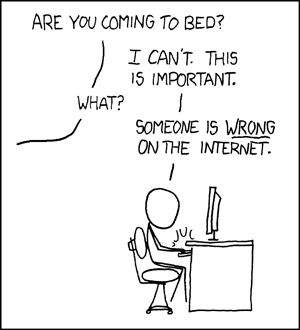
The following xkcd has, lately, been everywhere:

Other installments of the strip have been criticized for ambiguity, but until today, I hadn’t seen anyone complain about the construction of this one. Thus it was with some bewilderment, not to say bemusement, that I read Mark Liberman’s note saying that someone on the Internet believed the correct phrasing should be the following:

SOMEONE ON THE INTERNET IS WRONG.

Now, both choices of word order are perfectly grammatical, because “on the Internet” can be a locative adverbial phrase or a reduced relative clause. The question is one of timing, emphasis and not least euphony: people are wrong day in and day out, but it’s on the Internet that we can’t stop ourselves from criticizing them.

This past Saturday, I watched Kenneth Branagh’s Hamlet (1996) with two friends (he needed to write an essay about the play, and she’d wanted to see the movie since a few months back). Thus, I’m naturally primed to wonder if, according to the Internet, Marcellus should have lamented, “Something in the state of Denmark is rotten.”

Physics versus Fear

In the Channel 4 programme Breaking the Science Barrier (1996), Richard Dawkins faces down a pendulum:

This is a classic example of a “put your money (or nose) where your mouth is” physics demonstration. It also appears in Carl Sagan’s novel Contact (1985), for example, and Feynman did it during the freshman physics lectures he gave at Caltech.

Later in the same show, Dawkins interviews Douglas Adams, and gives a few comparisons to help understand the depths of evolutionary time:
Continue reading Physics versus Fear

Bloggers of the 1930s

I wonder if it’s true that you can only be a starry-eyed youngster once. I discovered the science fiction of Isaac Asimov when I was a ninth-grader, so far out of the social whirl that I didn’t even expect I was missing anything. I had my books and my BASIC compiler, and a few friends who shared my tastes in both, so what need had I for cheap beer? I collected the whole “Greater Foundation” series, from the Robot stories to the last Foundation book; Robots and Empire (1985) was the hardest to get, only turning up in my relatives’ used-book store in Seldovia, Alaska. Looking back through them in more recent years, big chunks don’t hold up that well, but I find myself inclined to view even the clunky and dated parts of, say, Pebble in the Sky (1950) with favor. Is it just sentiment at work? Do we each get a quota of one author we read through rose-tinted spectacles, just because they were the first we discovered?

When I try to put sentiment aside, I find that some stories still work, chief among them The Caves of Steel (1954). Still, if I want a book to read for “comfort food,” or to give myself an emotional pick-me-up and reinvigoration, I’m more likely to turn to Asimov’s non-fiction, from which there is plenty to choose. (I’d actually discovered the nonfiction first, several years before beginning my love affair with the Robot stories. For years, the only Asimov fiction I knew was the English-language screenplay of Gandahar (1988).) Among his best nonfiction is, funnily enough, his autobiography, of which there is also no shortage, as it comes in two strictly chronological volumes carrying his story through the 1970s, followed by a memoir published after his death and a book of his letters published after that.

All this is added value to make the passage I’m quoting today somewhat more admissible under “Fair Use” law. One of the fascinating things about Asimov’s autobiography is that it begins with his family history in Czarist Russia, on the borders of Belarus, then follows his nuclear family through Ellis Island into slum living in Brooklyn, then public school during the Depression, on through World War II. . . right the way to Watergate and, in the third volume, to glasnost and the TRS-80. One human life can cover a great deal of territory. Then come the odd moments of synchrony, when a bit of 1930s New York springs out at you and gains a strange relevance. To that end, here is In Memory Yet Green (1979), p. 209, describing the background to the Greater New York Science Fiction Club’s splitting into the Queens Science Fiction Club and the Futurian Science Literary Society, all the way back in 1938:
Continue reading Bloggers of the 1930s

Hypothesis Testing

Hypothesis: if you can take an idea which most people thought was the most hated concept in America this side of al-Qaeda’s mission statement and turn that idea into a book which stays on the New York Times bestseller list for almost a year, publishers will let you write your own ticket at least once.

Evidence: Richard Dawkins is being paid $3.5 million for his next book, Only A Theory? (to be published in 2009), which will lay out evidence for evolution.

Hypothesis: People who have a vested interest in portraying Dawkins and other “uppity atheists” as detrimental to science education and/or Western civilization will ignore or undervalue this book, along with all other attempts by “uppity atheists” to parlay their notoriety for good causes.

Evidence: Consider the reception (or non-reception) of Dawkins’s television series, The Enemies of Reason (2007). This is a lamentable oversight, since the struggle to keep pseudoscience out of medicine is surely an area on which atheists and at least some moderate theists can find a genuine common ground.

Hypothesis: I could sure have a lot of fun with $3.5 million.

Evidence: Forthcoming. Come on, in the interests of science, pretty please, with blueberries on top?

(Tip o’ the fedora to Tyler.)

Chuck and Bill on Darwin Day

In the morning, I found that a horribly complicated equation which mixed combinatorics, network theory and generalizations of Shannon entropy reduced to zero in a circumstance where I had guessed that might happen, which gave me the exciting feeling that I might actually be doing science.

In the evening, I went to meet Joshua, Expatria, Rebecca and Evelyn at the Redline bar for drinks and carousing. I misremembered the time of the meet-up, so I thought I had a while to kill, and consequently I idled down the street to the Harvard Coop bookstore — not with an intent to buy anything, just to browse. I found myself standing in front of their Shakespeare shelves, listening to the Baroque music being piped in by the bucketful, and I thought, “Holy Jebus, this is the very essence of highbrow and effete — and, damn it all, I love it.”

I picked up a book by Edwin Abbott Abbott, he of Flatland fame, on Shakespearean grammar, and I read its introductory sections until I figured it was time to head for the Redline. Stepping out of the bookstore, leaving behind all the testimonials on how the Network is changing everything, I saw a woman, homeless and shapeless under a once-pink blanket, sleeping or trying to sleep while the snow was beginning to fall. Take that as your allegory for Harvard Square, urban life, the twenty-first century or anything else which is too big for a single person to fix.
Continue reading Chuck and Bill on Darwin Day

Weekend Fluff: Luke As A Girl

I’ve been reading through Podblack Blog ever since the Podblack Cat hosted the Skeptic’s Circle (and kindly included an entry of mine). This is how I discovered that the Internets have a Carnival of Feminist SF, dedicated to feminist perspectives on science fiction. This is undeniably a good thing to have, although stumbling across it like this gives me an eerie feeling: for a kid who spent most of his teenage years reading SF, watching SF on the Tube or trying to write it himself, I know astonishingly little about SFnal happenings on the Internets. I fail at fandom.

(Or is that, in more modern parlance, “FANDOM: UR DOIN IT RONG”?)

Anyway, one of the entries in the carnival is Lisa Paitz Spindler‘s note on a new series of Star Wars merchandise based on Ralph McQuarrie’s early concept art. In one revision of the story which eventually became the first Star Wars movie, Luke Skywalker was a girl named Luka Starkiller. First, I should note, “Starkiller” is an impossibly corny name, even for a movie about samurai in space. Second, Spindler asks,

how might it have influenced Hollywood if the most popular sci-fi adventure flick ever had starred a kick-arse female protagonist?

I can’t give an optimistic response. The portrayal of women in the Star Wars saga is perpetually dismal, varied only by slight interruptions which make the missed opportunities in the rest all the more unbearable. Speculating about how the series would have turned out if, say, the sexes of Luke and Leia had been swapped is rather beside the point: why not ask how the movies would have developed if an entirely different creator had been the driving force?
Continue reading Weekend Fluff: Luke As A Girl

The Name is Planck, Max Planck

The algorithm informs me that the title for the next James Bond movie, the sequel to the franchise reboot Casino Royale (2006), will be titled Quantum of Solace. This title comes from a short story in Ian Fleming’s collection For Your Eyes Only (1960); the movie of that name used elements from two stories in the book, a third story became part of Licence to Kill (1989), and the title of a fourth story was affixed to the film A View To A Kill (1985).

The title “Quantum of Solace” appears in the story as the smallest possible unit of human compassion. The following paragraph appears in both the Everything2 article on the story (dated 6 March 2001) and today’s Telegraph piece about the movie:

The crux of the story is the emotional phenomenon the Governor calls the Quantum of Solace, the smallest unit of human compassion that two people can have. As long as that compassion exists, people can survive, but when it is gone, when your partner no longer cares about your essential humanity, the relationship is over.

Well, OK, Lucy Cockcroft’s story in the Telegraph doesn’t have the words “of the story” following “crux.” Eit!

Popularizers of physics are going to have a field day with this one. Perhaps, just perhaps, we’ll finally have an example of quantum meaning small!