
Xiaojuan Sun, Matjaz Perc, Qishao Lu, and Jürgen Kurths, “Spatial coherence resonance on diffusive and small-world networks of Hodgkin-Huxley neurons” (arXiv:0803.0070, accepted for publication in Chaos).
Continue reading Currently Reading
Category Archives: Plectics
Physics on the Brain, Part 1
 Can physics tell us about ourselves?
To phrase the question more narrowly: can the statistical tools which physicists have developed to understand the collective motion of large agglutinations of particles help us figure out what our brains are doing?
If Jack Cowan and his colleagues are correct, ideas from statistical physics can tell us important facts about our own brains. By studying the recurring motifs of hallucinations, we can construct a geometry of the mind.
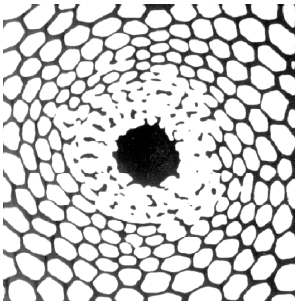
“Honeycomb” form constant,
from Bresloff, Cowan et al. (2002)It’s hard to imagine any sort of regularity in a phenomenon as eccentric as visual hallucinations. Our culture is brimming with psychedelia, music and art produced “under the influence” of one or another infamous chemical. Yet the very fact that we can label artwork as “psychedelic” suggests that the effects of those mind-bending substances have a certain predictability. In the 1920s, long before the days of review boards and modern regulations for human experimentation, the neurologist Heinrich Klüwer ingested mescaline and recorded his observations. He reported visual hallucinations of four distinct types, which he called “form constants.” These form constants included tunnels and funnels, spirals, honeycomb-like lattices and cobweb patterns. Similar structures have been reported with other drugs, like LSD; these same form constants also appear during migraines, in “hypnogogic” (falling asleep) and “hypnopompic” (waking up) states, when pressure is applied to closed eyes, and even in ancient cave paintings.
If the same hallucinatory images appear from many causes, might they be indicative of some more general property of brain structure?
Continue reading Physics on the Brain, Part 1
On the arXivotubes
I’ve had clustering behavior in randomly generated networks on my mind, recently, so arXiv:0802.2508 naturally caught my eye. It’s entitled “Criticality of spreading dynamics in hierarchical cluster networks without inhibition.” Marcus Kaiser, Matthias Goerner and Claus C. Hilgetag write,
Continue reading On the arXivotubes
In Happier News, the ArXivotubes
Luciano da Fontoura Costa, “Communities in Neuronal Complex Networks Revealed by Activation Patterns” (arXiv:0801.4684):
Recently, it has been shown that the communities in neuronal networks of the integrate-and-fire type can be identified by considering patterns containing the beginning times for each cell to receive the first non-zero activation. The received activity was integrated in order to facilitate the spiking of each neuron and to constrain the activation inside the communities, but no time decay of such activation was considered. The present article shows that, by taking into account exponential decays of the stored activation, it is possible to identify the communities also in terms of the patterns of activation along the initial steps of the transient dynamics. The potential of this method is illustrated with respect to complex neuronal networks involving four communities, each of a different type (Erdös-Rény, Barabási-Albert, Watts-Strogatz as well as a simple geographical model). Though the consideration of activation decay has been found to enhance the communities separation, too intense decays tend to yield less discrimination.
The “simple geographical model” is one I’ve played with myself, since it’s so easy to implement (and serves as a null hypothesis for some problems of interest). Throw [tex]N[/tex] nodes into a box of [tex]d[/tex] dimensions, and connect two nodes if they are closer than some fixed threshold. In this case, the box was 2D, but a 3D version is just as easy to implement.
Currently Reading
Oliver Johnson, Christophe Vignat (2006). Some results concerning maximum Renyi entropy distributions.
We consider the Student-t and Student-r distributions, which maximise Renyi entropy under a covariance condition. We show that they have information-theoretic properties which mirror those of the Gaussian distributions, which maximise Shannon entropy under the same condition. We introduce a convolution which preserves the Renyi maximising family, and show that the Renyi maximisers are the case of equality in a version of the Entropy Power Inequality. Further, we show that the Renyi maximisers satisfy a version of the heat equation, motivating the definition of a generalized Fisher information.
Luciano da F. Costa, Francisco A. Rodrigues, Gonzalo Travieso, P. R. Villas Boas (2006). Characterization of complex networks: A survey of measurements.
Continue reading Currently Reading
ICCS: Time-Dependent Networks
Yesterday, the International Conference on Complex Systems wrapped up with five talks on networks. For me, the most interesting was that by Dan Braha, who spoke about what happens when you analyze a system as a network which changes over time, instead of the aggregate network formed by lumping all the timesteps together. Imagine a system made out of a whole pile of parts. At time [tex]t[/tex], part number [tex]i[/tex] might or might not be interacting with part number [tex]j[/tex], which we could represent as a time-varying matrix [tex]C_{ij}(t)[/tex]. Many studies of network-related phenomena obscure the time-dependence part. For example, in a living cell, genes are switching on and off, concentrations of enzymes are going up and down, and all sorts of stuff is changing over time. You can mix proteins A, B and C in a test tube; perhaps A bonds both to B and to C. You’d then draw an interaction network with links connecting A to B and to C — but what if B and C are never present in the cell at the same time?
Braha and company looked at a collection of e-mails sent over 113 days, exchanged among 57,138 users. (The data comes from arXiv:cond-mat/0201476v2, published five years ago in Phys. Rev. E, and were gathered at Kiel University.) A node is an individual e-mail address, and a link is established when a message is sent from one address to another. They found, among other things, that whether or not a particular node is a “hub” changes over time: popular today, an outcast tomorrow. Moreover, a node which is in the top 1000 most connected on one day may or may not be in the top 1000 for the aggregate network. Furthermoreover, when the window of aggregation is gradually increased — from one day to two days, to a week, up to the entire time period — the similarity to the total aggregate network increases, as you’d expect, but without any threshold.
In the last few minutes of his talk, Braha did a brief overview of a related investigation, in which they studied a “social network” derived from Bluetooth devices. If my Bluetooth gizmo is within two meters of yours, we’ll call that a link. The network of Bluetooth devices will naturally change over time, so we can do the same comparison between the graphs observed at short timesteps to the graph formed by aggregating all connections. During the Q&A session afterwards — before I had to, ironically enough, run off to find my cell phone — I pointed out something which it appears Braha hadn’t fully grasped.
Continue reading ICCS: Time-Dependent Networks
ICCS: Pictures
I seem to have become the official Conference Paparazzus. Some of my photos are standard conference fare. For example, here’s Gregory Chaitin having a chat with his session chair, Bob Savit:

However, every picture I have of Philip Zimbardo looks at least a little. . . evil.

This is, in fact, how many of the people in the audience will remember Dr. Zimbardo:
Continue reading ICCS: Pictures

Update on the D-Word
Dwight Read is another academic who uses the word Darwinism to refer to evolution by natural selection. During his plenary talk this morning, Read spoke of “Universal Darwinism,” Dawkins’ term for the idea that natural selection is not substrate-specific and can in principle be applied to non-biological things, like cultural memes.
As I mentioned earlier, it’s folklore among the science-blogging community that British academics are more likely to use “Darwinism” in this sense than Americans are. (Over here, hearing the D-word is a pretty sure sign you’re dealing with a creationist, or at least somebody whose knowledge derives too much from creationist sources. I wonder if there’s also a bit of national pride at work.) Read is currently at UCLA, but in 1999 was a visiting professor at the University of Kent, Canterbury.
Fellow Travelers in Complexity
Jacob Jesson of Shared Context is also blogging ICCS.
ICCS: Emergence in Particle Systems 1
I typed the following notes during Hiroki Sayama‘s presentation on “Phase separation and dynamic pattern formation in heterogeneous self-propelled particle systems.” Unfortunately, I couldn’t get a WiFi signal in the room where Sayama gave his talk, so I’m falling short of the gonzo science ideal, posting about the talk after it was given instead of as it occurs.
Sayama is speaking about particle swarm systems, and the phase-separation and dynamic pattern formation behaviors they exhibit. He adds the novel feature of heterogeneity to the particle system. Research on self-propelled particles goes back to Reynolds (1987), Vicsek et al. (1995), Aldana et al. (2003), Chuang et al. (2006), etc. Reynolds was a computer scientist who created a method for simulating bird flocking, which developed into the simulation which created the bats in the otherwise unremarkable Batman Begins. Vicsek and Aldana were physicists.
These systems show collective behaviors such as random clustering, coherent motions and milling. The same system can exhibit all of these behaviors, depending upon the input parameters. Cranking up the noise can induce phase transitions. Almost all of this work focused on homogeneous particle systems, in which all particles share the same kinetic particles. What, then, would happen if two or more types of self-propelled particles were mixed together?
Sayama works in a framework he calls Swarm Chemistry, which is implemented as a Java applet that can be run online.
Continue reading ICCS: Emergence in Particle Systems 1
ICCS: Monday Evening
The parts between talks are the best parts of conferences. Sure, it’s great to hear Greg Chaitin deliver his sermon about the ideal realm of pure mathematics being an infinite ocean of complexity, out of which we can only seize finite buckets — but Chaitin writes about that kind of thing, and you can read it for free online. It’s an altogether different experience to discuss during the coffee break Mike Stay and Cristian Calude’s paper, “From Heisenberg to Gödel via Chaitin,” with one of the three men in the title.
Question-and-answer sessions after the presentations can also be quite good. Last night, for example, Barbara Jasny of Science Magazine explained how that publication is adapting to the whizbang modern world. It’s reassuring to hear that at least one person in the publishing community has a common-sense understanding of what cheap, open digital access means: journals can only justify charging prices if those prices reflect the actual value which those journals add. More interesting than that, however, was Jasny’s reaction to the question from Frannie Leautier, former Vice-President of the World Bank and currently head of the World Bank Institute. Leautier asked if Science would publish articles which used cartoons as illustrations (instantly endearing herself to all the Larry Gonick and Sid Harris fans in the audience).
Continue reading ICCS: Monday Evening
ICCS: Sunday Morning
The following is my first attempt to liveblog ICCS 2007. I arrived at the Quincy Marriott shortly before 8:30 this morning, having driven south on I-93 from Boston. Unlike the first time I drove out here, I didn’t get lost in Braintree, since I took the left fork at the “Braintree split,” where I-93 undergoes mitosis. These things are important to know.
The morning’s plenary talks began with Diana Dabby (Franklin W. Olin College of Engineering), who spoke about chaotic transformations one can apply to music in order to generate musical variations, as in “Variations on a Theme of Beethoven.” Her scheme begins by breaking the musical performance into a sequence of pitches, denoted [tex]p_i[/tex], and then mapping each [tex]p_i[/tex] to a section of a dynamical trajectory on a chaotic attractor like the Lorentz owl/butterfly mask.
Continue reading ICCS: Sunday Morning
Superconductors via Superstrings
Nature has an article about a nifty and relatively new application of ideas born out of string theory: to understand what happens in high-temperature superconductors! The story goes something like this.
Take a sample of some material which can conduct electricity, and apply two kinds of outside influence upon it. First, stick it in a magnetic field pointing in some direction, and second, apply a temperature gradient in a direction perpendicular to the magnetic field. In some substances, an electric field will appear, perpendicular to both the magnetic field and the temperature gradient. This is called the Nernst effect. It doesn’t happen very much with ordinary metals, but in semiconductors — like silicon or germanium — it can be quite noticeable. It also appears in some superconductors, like Y-Ba-Cu-O and CeCoIn5 to name but two.
Sean A. Hartnoll et al. have cooked up a theory to explain the Nernst effect and other behaviors seen in the cuprate superconductors, ceramic compounds containing copper. Looking at the situation near the phase transition, where a substance is “on the verge” of changing from insulator to superconductor, they developed a theory involving the magnetic field, call it [tex]B[/tex], and fluctuations in the material’s density, [tex]\rho[/tex]. Then they looked at this theory in the conceptual mirror known as the AdS/CFT correspondence. This connection between seemingly disparate ideas takes you from a “conformal field theory,” the sort of math involved with the superconductor problem (among other things), to a theory of gravity in a type of universe called anti-de Sitter space. In this mirror-world description, the perturbations in [tex]B[/tex] and [tex]\rho[/tex] become magnetic and electric charges of a black hole sitting in the AdS universe!
Continue reading Superconductors via Superstrings
Don’t Make Baby Gauss Cry
Cosma Shalizi writes of “Power-Law Distributions in Empirical Data“:
Because this is, of course, what everyone ought to do with a computational paper, we’ve put our code online, so you can check our calculations, or use these methods on your own data, without having to implement them from scratch. I trust that I will no longer have to referee papers where people use GnuPlot to draw lines on log-log graphs, as though that meant something, and that in five to ten years even science journalists and editors of Wired will begin to get the message.
Mark Liberman is not optimistic (we’ve got a long way to go).
Among several important take-home points, I found the following particularly amusing:
Continue reading Don’t Make Baby Gauss Cry
Power-law Distributions in Empirical Data
Throughout many fields of science, one finds quantities which behave (or are claimed to behave) according to a power-law distribution. That is, one quantity of interest, y, scales as another number x raised to some exponent:
[tex] y \propto x^{-\alpha}.[/tex]
Power-law distributions made it big in complex systems when it was discovered (or rather re-discovered) that a simple procedure for growing a network, called “preferential attachment,” yields networks in which the probability of finding a node with exactly k other nodes connected to it falls off as k to some exponent:
[tex]p(k) \propto k^{-\gamma}.[/tex]
The constant γ is typically found to be between 2 and 3. Now, from my parenthetical remarks, the Gentle Reader may have gathered that the story is not quite a simple one. There are, indeed, many complications and subtleties, one of which is an issue which might sound straightforward: how do we know a power-law distribution when we see one? Can we just plot our data on a log-log graph and see if it falls on a straight line? Well, as Eric and I are fond of saying, “You can hide a multitude of sins on a log-log graph.”
Via Dave Bacon comes word of a review article on this very subject. Clauset, Shalizi and Newman offer us “Power-law distributions in empirical data” (7 June 2007), whose abstract reads as follows:
Continue reading Power-law Distributions in Empirical Data
Chaos, Phase Transitions and Topology
Ben has suggested the following paper as a target for our discussion. We should, he says, have the necessary background by the end of the summer.
- Lapo Casetti, Marco Pettini, E. G. D. Cohen. “Geometric approach to Hamiltonian dynamics and statistical mechanics” Physics Reports 337, 237 (2000).
As the abstract says, the paper is divided into two main parts:
Continue reading Chaos, Phase Transitions and Topology