Category Archives: Pseudoscience

Reflections

Prompted by this review of Colin McGinn’s Basic Structures of Reality (2011), I read a chapter, courtesy the uni library. It was endumbening. To the extent that he ever has a point, he says in many words what others have said more clearly in few. He confuses the pedagogy of a particular introductory book with the mature understanding of a subject, displays total ignorance of deeper treatments of his chosen topic, blunders into fallacies, and generally leaves one with the impression that he has never done a calculation in all the time he spent “studying physics”. Truly an amazing achievement.

A few years ago, I might have blogged my way through the whole darn book. I must be getting old (“REALLY? NO WAY!” declares my weak knee). But is it a healthy and mature sense of priorities, or a senescent academic crustiness? Have I become one of those people, concerned with my vita to the exclusion of all else? Dark thoughts for this cold autumn evening, dark as our current season of superhero movies—Fimbulwinter 3: Flame of Despair….

“The Business of Skepticism is to be Dangerous”

Lately, I’ve found my thoughts returning to a passage of Carl Sagan which I first read years and years ago.

The business of skepticism is to be dangerous. Skepticism challenges established institutions. If we teach everybody, including, say, high school students, habits of skeptical thought, they will probably not restrict their skepticism to UFOs, aspirin commercials, and 35,000-year-old channelees. Maybe they’ll start asking awkward questions about economic, or social, or political, or religious institutions. Perhaps they’ll challenge the opinions of those in power. Then where would we be?

That’s from The Demon-Haunted World, chapter 24, page 416. I read that book as a child. I still remember the sensation of coming-to-wakefulness which that reading brought. Since then, I’ve grown taller and greyer and just a touch more bitter. I broke my heart a couple times, got my name into the learned journals here and there, and witnessed more than a few laudatory invocations of St. Carl of Ithaca.

I should have been less surprised to learn that skeptical institutions, fancy ones with Inquiry and Education in their names, belong on that list too.

It is difficult to have patience for those who restrict their community-building to those who need it least.

EDIT TO ADD: Basically, this.

If you want an effective movement with a broad reach, this is roughly the dumbest move you could make. However, if your goal is to reinforce the public’s belief that secularism and atheism particularly is nothing but a bunch of misanthropic white guys whose only real goal is feeling superior to believers but who don’t care about making real change in the world, well job well done. And fuck you.

The Transparent Academy

You know what I’d like to see? I’d like to have all the course materials necessary for a good, solid undergraduate physics degree available online, free to access and licensed in a way which permits reuse and remixing. I’d like it all in one place, curated, with paths through it mapped out to define a curriculum. When I say all the course materials, I mean that this webzone should have online textbooks; copies of, or at least pointers to, relevant primary literature; video lectures; simulation codes; sample datasets on which to practice analysis; homework and exam problems with worked-out solutions; interactive quizzes, so we can be trendy; and ways to order affordable experimental equipment where that is possible, e.g., yes on diffraction gratings, but probably no on radioactive sources. I’m talking about physics, because that’s what I nominally know about, but I’d like this to encompass the topics which I got sent to other departments to learn about, like the Mathematics Department’s courses in single- and multivariable calculus, differential equations, linear algebra, group theory, etc.

One way to think about it is this: suppose you had to teach a physics class to first- or second-year undergraduates. Could you get all the textual materials you need from Open-Access sources on the Web? Would you know where to look?

What with Wikipedia, OpenCourseWare, review articles on the arXiv, science blogs, the Khaaaaaan! Academy and so forth, we probably already have a fair portion of this in various places. But the operative word there is various. I, at least, would like it gathered together so we can know what’s yet to be done. With a project like, say, Wikipedia, stuff gets filled in based on what people feel like writing about in their free time. So articles grow by the cumulative addition of small bits, and “boring” content — parts of the curriculum which need to be covered, but are seldom if ever “topical” — doesn’t get much attention.

I honestly don’t know how close we are to this ideal. And, I don’t know what would be the best infrastructure for bringing it about and maintaining it. Idle fantasies and pipe dreams!

I’d like to have this kind of resource, not just for the obvious practical reasons, but also because it would soothe my conscience. I’d like to be able to tell people, “Yes, physics and mathematics are difficult, technical subjects. The stuff we say often sounds like mystical arcana. But, if you want to know what we know, all we ask is time and thinking — we’ve removed every obstacle to your understanding which we possibly can.”

I don’t think this would really impact the physics cranks and crackpots that much, but that’s not the problem I’m aiming to (dreaming that we will) solve. Disdain for mathematics is one warning sign of a fractured ceramic, yes: I’ve lost count of the number of times I’ve seen websites claiming to debunk Einstein “using only high-school algebra!” We could make learning the mathematical meat of physics easier, but that won’t significantly affect the people whose crankishness is due to personality and temperament. Free calculus lessons, no matter how engaging, won’t help those who’ve dedicated themselves to fighting under the banner of Douche Physik.

Alchemists work for the people. —Edward Elric

Signature in the Cell (Repost)

For your convenience:

The following is a list of debunkings of Stephen C. Meyer’s Signature in the Cell, arranged more or less in chronological order. I have not included every blog post I’ve seen on the topic; as I did for Behe’s The Edge of Evolution, I’ve focused on the most substantive remarks, rather than keeping track of every time somebody just quoted somebody else. (I’ve also probably overlooked, forgotten, mistakenly thought I’d already included or never been made aware of some worthwhile essays.) In some cases, additional relevant posts can be found by following links within the essays I have listed.
Continue reading Signature in the Cell (Repost)

Colony Collapse Disorder

Bug Girl takes on a recent paper which claimed to find evidence that cell phones have it in for beehives. The punchline:

This paper (which for a student research paper would be questionable) should not have been in a journal. It definitely should not have postulated a connection to Colony Collapse Disorder.
And it should never have made the levels of press exposure that it did.

Read the rest at her blag.

Monday BPSDB: Null Physics

BPSDBA fellow named Terry Witt has been advertising his self-published book, Our Undiscovered Universe, in places like Discover magazine and Scientific American. Unfortunately, the ad pages aren’t exactly peer-reviewed, or even cross-checked with a nearby grad student; being businesses, magazines naturally care about revenue. Upon examination, Our Undiscovered Universe turns out to be brimming over with crank physics and general nonsense. Ben Monreal, who was one of the intimidatingly smart people in the lab where I did my undergrad thesis, has weighed Witt’s “Null Physics” and found it wanting; his review of Our Undiscovered Universe is quite a good read.

Witt’s book starts with pseudomathematics before moving on to pseudophysics. As Ben explains,

Chapter 1 is where Witt lays out a series of “proofs” derived from what he calls the “Null Axiom”. That axiom is: “Existence sums to nonexistence” (pg. 28)—something that Witt calls self-evident after a page of invalid set theory. The central mistake, if I had to identify one, is the claim that “X does not exist” is the same as “everything except X exists”. This is utter baloney, whether in formal logic or in set theory or in daily experience.

Actually, as the book unfolds, Witt doesn’t appear to use this dead-in-the-water non-axiom for anything. He does, however, pile on more pseudomathematics:

Chapter 3 contains such gems as Theorem 3.1: “The Existence of Any Half of the Universe is Equal to the Nonexistence of the Other Half” (pg. 66) and Theorem 3.9: “The Time Required for Light to Traverse the Universe is Eternity, infinity/c” (pg. 72). I am not making this up. Witt throws around “infinity” as though it were an ordinary real number; he multiplies and divides by it, etc., with normal algebraic cancellation. This is complete nonsense; there are two centuries of mathematical thought figuring out the mathematical properties of infinity, and Witt’s approach is valid in exactly none of them. (Witt later explained on his online forum—currently disabled—that he’s reinvented all of the mathematics associated with “infinity”. His reasoning, if that’s what you call it, was that his new definition jibed with a grand idea about math being dependent on nature; it was an argument from incredulity.)

When Witt does finally get around to physics, five chapters into the book, he doesn’t do any better.
Continue reading Monday BPSDB: Null Physics

Quantum Woo, Part N

BPSDBTime for a little BPSDB! The redoubtable Ben Goldacre has the dirt on Bill Nelson’s “QXCI machine,” a device for “bioenergetic health auditing,” a medical procedure well-known among specialists as an essential step in the surgical removal of cash from wallets. Best of all, though, is what QXCI stands for: Quantum Xrroid Consciousness Interface. Now, quantum physics has jack to do with consciousness, but more importantly, “quantum xrroid” just sounds. . . painful. Like a blood boil growing inside your X, if you know what I mean.

Maybe a “quantum xrroid” means that your X is in a superposition of inflamed and not inflamed and only settles on one or the other option when your doctor examines it.

(Incidentally, I met the redoubtable Ben Goldacre in Vegas a few weeks ago — and thereby would hang a tale, if he weren’t still hoarding the photo evidence.)

Antiscience in Maine

BPSDBMatthew Linkletter, a Board of Directors member of Maine’s School Administrative District 59, has been trying to squelch science education in his district. How? By throwing creationist canards at his listeners and banking on their ignorance. Reports a local Kennebec newspaper,

Linkletter suggested during last week’s SAD 59 board meeting that the board discuss evolution, the “Big Bang Theory” and other studies he believes should be deleted from the curriculum. […] Linkletter said he wants the best science for SAD 59 students, who should “be armed with the truth.” They should be able to explain the origins of life according to evolution if it is taught in the schools, he said.

“Nobody has the answer to the origins of life. It’s a philosophical question.”

OK, stop right there. First of all, the origin of life is not a “philosophical question,” but one which we can approach scientifically, and indeed have already learned a great deal about. Second, the open questions which remain about abiogenesis do not impair our ability to understand what has happened since then, in the later evolutionary history of life, any more than our limited knowledge of how humans discovered fire or invented writing affects historians’ ability to know about the American Revolution. Finally, the Big Bang is a theory like gravity is a theory — so go away now, won’t you, and try to brush up on your own science education before ruining other people’s?

Unfortunately, others are chiming in against the cause of knowledge and fact:
Continue reading Antiscience in Maine

News From the Home State

Several bills have died recently in the Alabama State Legislature. According to an AP wire report, one of them would have “protected teachers from being fired for giving personal opinion while teaching controversial subjects like evolution.” In other words, the “Academic Freedom Act,” whose purpose really was to protect the teaching of creationism, has croaked. Let’s celebrate!

Oh, wait. Another bill which died would have “repealed the state’s ban on sex toys.”

Darn! The Darwinist agenda has been foiled once again!

(Tip a’ the fedora to Sensuous Curmudgeon.)

Basing Hopes on Pseudoscience

BPSDBOnline polls are not scientific. To state the matter more precisely, a poll on a website which is open to the entire Network and has only minimal measures to guard against repeat voting measures the people who were motivated to respond, not a representative sample of the population. Of course, it’s just like a creationist — beg pardon, a cdesign proponentsist — to rely upon a pseudoscientific tool for spurious validation of his pre-established beliefs. It is also in the nature of things that, on the Network, such attempts will backfire.

To wit, consider the poll on the Expelled! movie‘s MySpace page. The question was asked, “Do you think the theory of Intelligent Design should be taught in our education system?” The Evil Darwinismistic Conspiracy was alerted to the poll at 10:36 AM Eastern Time, and less than five hours later, this is where the results stand:
Continue reading Basing Hopes on Pseudoscience

Quote of the Day

This is Jay Davis, reviewing the movie Expelled! in the Real Detroit Weekly (23 April 2008).

Proponents of ID are fond of saying that it’s not the same as creationism (read: creationism sans the talking snake and the magic rib). But if ID isn’t creationism, then oral sex isn’t sexual relations.

Davis suggests that if we start teaching Intelligent Design in the schools, we should also teach Deliberate Motion as an alternative to classical mechanics (planets move because of “an Intelligent Mover pushing them around,” don’t ya know?). While we’re at it, the germ “theory” of disease is just a theory, so we should embrace the controversy and present it alongside “Divine Retribution theory.” Commenters at Orac’s site have already pointed out that while promoting Expelled!, Ben Stein has made remarks which sound more than a little like “Deliberate Motion.” For example,

Assuming it all did happen by Random Mutation and Natural Selection, where did the laws of gravity come from?

And, come to think of it, Michael Behe’s dystheistic view of Intelligent Design is basically a Divine Retribution theory of disease. He concedes that drug resistance could have evolved, although his understanding of it is spectacularly bad, and his attempts to use it as an “edge of evolution” are irredeemably flawed. But while the malaria parasite’s resistance to medications could possibly have evolved, Behe says, malaria itself was intelligently designed.

Oh, and before I vanish back into my silent retreat, I should add that Skeptic’s Circle #85 is now online at Andrea’s Buzzing About.

Creation, Power and Violence

The amount of hatred one can earn simply by speaking one’s mind and doing one’s job never fails to astonish me. All the more remarkable is how the people who hate so viciously are the very ones you’d expect to be tolerant, or at least quietly begrudging — people whose ancestors, both familial and ideological, were themselves the targets of bigotry in generations past, when different powers were the oppressors. Yet today, even in a country which prides itself on a long list of freedoms, speaking the plain, factual truth of the world is a sure way to win oneself ire, derision and abuse.

Both history and current events teach us that forces of prejudice and inequity oppose the dissemination of truth to certain sectors of society. As recently as 2006, the Afghan schoolteacher Mohammed Halim was drawn and quartered by motorbikes, the remains of his body put on display so that others would think twice before defying Taliban law and committing the unforgivable crime of teaching female children. I doubt the Taliban thugs who beat the algebra teachers of Ghazni have any particular animosity towards the mathematics; given a moment’s reflection, they might wholeheartedly support the math lessons necessary to train engineers who then build weapons to be used against the United States. The crime in their eyes, I’d wager, is not the material, but the audience.

In the country where I grew up and am writing now, the story is a little different: most of the time, hatred against educators does not escalate to physical violence, although threats of violence are common enough, and most of the time, the factor provoking abuse is not the audience, but the lesson itself.

The plain truth I’m talking about is the biological principle of evolution. The single most powerful idea in biology, this discovery has withstood decades of criticism to emerge triumphant as one of the most well-checked propositions in human history. Learn about evolution, and you can go to work on diseases, or help find out where species both living and extinct fit into the family tree of life. You can understand the living world, and help preserve human life within it.

Open your mouth about evolution around the wrong people, though, and you can find yourself harassed, ejected from your job and even beaten in the street.

Just ask these people.
Continue reading Creation, Power and Violence

Expelled: Immoral, Incompetent

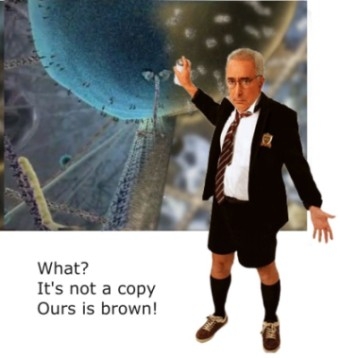
BPSDBAnd so it came to pass that the creationists, realizing that they would be caught ripping off copyrighted material for their propaganda movie, pushed back the release date and did a quick hack job to cover up the stolen footage. Unfortunately, having no actual knowledge of science — if they did, they wouldn’t be creationists — their replacement was rather lacking in the originality department, and the subterfuge did not last.

Just how derivative was the hack job the propagandists threw together? Well, if XVIVO‘s original “Inner Life of a Cell,” beautiful although somewhat inaccurate, were the riff from “Under Pressure,” then the clip seen in the Expelled movie would play the role of “Ice Ice Baby.” Quidam makes the point more succinctly than I could try:

quidamsretort.jpg

At once immoral and incompetent: that’s Expelled for you.

The whining and flailing attempts at damage control have already begun, as Tyler dutifully summarizes. I am hardly surprised to note that the refrain “the Darwinists are trying to censor the truth” has already been sounded. Like clockwork, these people are. Here’s a friendly memo: if you stopped doing flagrantly illegal things, it might be more difficult for the mean, nasty evilutionist bogeymen to bring the strong arm of the Man down upon you. Not that we should expect this FYI to sink in, of course — their media message is now “Help, help, we’re being repressed,” when it’s plain to see that the petty authorities who’ve given their bigotries free rein have been creationists lashing out at science. Do the names Steve Bitterman, Alex Bolyanatz, Richard Colling, Chris Comer, Paul Mirecki, Nancey Murphy, Gwen Pearson and Eric Pianka ring any bells? How about the name of Judge John E. Jones III, who became the target of character assassination and even received death threats for the crime of doing his job? I keep waiting for a biochemist or a geneticist to start issuing death threats like Michael Korn sent to UC Boulder’s biology department, those “terrorists against America.” So far, I wait in vain.

Scientists are men and women with all the foibles inherent in being human. The scientific process seeks to counter some of these flaws through openness and mutual cross-criticism — not always successfully, but often enough to make real progress. Professional creationism, on the other hand, is a disease of the moral organs. It is impossible to defend in an honest way blatant untruths such as the assertions at the heart of creationism; the ignorance and dishonesty inherent in that defense will inevitably infect all aspects of the practice.

(Thanks to the Bad Idea Blog for spotting the image.)

POSTSCRIPT: Above, I described the XVIVO animation as “beautiful although somewhat inaccurate.” The chief illustrator of the film, David Bolinsky, has elaborated on this point:
Continue reading Expelled: Immoral, Incompetent