Category Archives: University education

Sex and the Single Equation

If you shared that old McSweeney‘s piece about “physical theories as women”, you can’t complain about Luce Irigaray calling $E = mc^2$ a “sexed equation”.

This is a famous remark by Irigaray that science fanboys like to trot out as proof that gender studies, or sociology of science, or whatever they don’t like at the moment is all bullshit. But when you dig up the source, it’s Irigaray basically spit-balling during a Q&A, taking a question and running with it.

Yet this example of “philosopher’s gonna philosophy” took on a life of its own when Alan Sokal and Jean Bricmont quoted it (incompletely, as we shall see) in their book Fashionable Nonsense: Postmodern Intellectuals’ Abuse of Science. Richard Dawkins featured it prominently in his review of Fashionable Nonsense, and it doesn’t seem to have gone out of style since.

The full citation is L. Irigaray, “Sujet de la science, sujet sexué?”, in Sense et place des connaissances dans la société, 3 (Centre national de la recherche scientifique, 1987), pp. 109–110. (This is the third volume in a series; Sokal and Bricmont’s bibliography omits the volume number.) The question begins on p. 109:
Continue reading Sex and the Single Equation

Second Chance

When I have been stuck on the research front, I have turned to typing up my lecture notes for the past couple semesters and merging them into the notes I already had, to make a book-shaped document.

My organizing theme is to cover the explanations that made things finally click for me, the second or third time I studied a subject. The working title is Second Chance: Unorthodox but Personally Effective Explanations in Probability and Physics.

Without the personal angle, I wouldn’t have the motivation to work on it, but because it is such a me book, the barrier to collaborating is even higher than it is with all other writing projects. The other downside is that because it’s not a plug-and-play replacement for a specific textbook that already exists, it doesn’t directly further the goal of giving curriculum materials away for free to burn down the publishing industry. (It’s kind of advanced undergraduate/early graduate level thermodynamics/statistical/quantum physics, with supplements on the mathematics required. So, it’s too offbeat to be a “free Griffiths”.)

From Newton–Euler to Hamilton–Jacobi

Let’s say that we want to reformulate “Newtonian” particle mechanics so that it looks analogous to wave motion, in order to make our knowledge of one math subject applicable to another. A light ray, minding its own business, propagates in the direction perpendicular to its wavefronts. So, the particle momentum should be perpendicular to lines of something, meaning that it should be the gradient of something:
$$
\vec{p} = \vec{\nabla} S \, .
$$
We don’t know what $S$ is, except that it’s a field whose value presumably depends upon position and time, and it ought to satisfy some equation. Can we find an equation for it?
Continue reading From Newton–Euler to Hamilton–Jacobi

Free Physics (and Math) Books

Challenge: Think of any physics book that is known by its author’s last name.

OK, what is its free replacement?

A variant on this question: How much of the MIT undergraduate physics curriculum can be taught with free books? The only reasonable answer would be all of it, because we’ve had the Web for 30 years now. Sadly, the textbook business is not reasonable.

If people had decided to be useful at any point in the past generation, you could go to physics.mit.edu and click to download all-the-textbooks-you-need.tgz, but we got MOOCs instead. Not to mention the “open courseware” that too much of the time is just a stack of PowerPoints. Oh, and software that puts kids under surveillance so that a company can monetize their behavior. Because that’s the future we deserved, right?

There are books out there, but they peter out after you get past the first year or so, and a lot is pitched either too low or too high. Either there’s a few chapters in a big “university physics” kind of volume that wouldn’t be enough to fill a whole semester, or there’s a substantial text that’s intended for graduate students. Plenty of times, one finds a totally decent set of lecture notes that whiffs at the last step by not incorporating homework problems. If we really want institutional change, we need (among other things) more drop-in replacements for the books to which physicists habitually turn, so that we can overcome the force of tradition.

In what follows, I go through the MIT course catalogue and provide links and commentary.
Continue reading Free Physics (and Math) Books

Rolling up the Bloch Ball

In an earlier post, we discussed how to do quantum mechanics for the simplest possible quantum system, a single qubit, using expectation values. What if we want to apply quantum theory to a bigger system, like multiple qubits put together? This is where the standard mathematical language of the subject starts to pay off. It is possible to keep working with expectation values the way we were, and in some applications it is even beneficial. However, expressing what the valid set of preparations looks like is difficult to do without bringing in more of the linear algebra.

I’ve taught this to college students, after first reviewing how complex numbers work and some basics about how to manipulate matrices — adding them, multiplying them, taking the trace and the determinant, what eigenvalues and eigenvectors are.

For our own purposes, our next step will be to develop the framework in which we can consider multiple qubits together. It might not seem obvious now, but a good way to make progress is to combine our three expected values $(x,y,z)$ into a matrix, like so:
$$ \rho = \frac{1}{2} \begin{pmatrix} 1 + z & x – iy \\ x + iy & 1 – z \end{pmatrix} \, . $$
This matrix has some nice properties of the sort that we can generalize to bigger matrices. For example, its trace is 1, which feels kind of like how a list of probabilities sums up to 1. Meanwhile, the determinant is the pleasingly Pythagorean quantity
$$ \det\rho = \frac{1}{4}(1 – x^2 – y^2 – z^2) \, . $$
This will be nonnegative for all the valid preparation points. So, the product of the two eigenvalues of $\rho$ will be positive for every point in the interior; we can only get a zero eigenvalue by picking a point on the surface. Using the trace and the determinant, we can find the eigenvalues thanks to a nifty application of the quadratic formula:
$$ \lambda_\pm = \frac{\mathrm{tr}\rho \pm \sqrt{(\mathrm{tr}\rho)^2 – 4\det\rho}}{2} = \frac{1}{2}(1 \pm \sqrt{x^2 + y^2 + z^2}) \, . $$
And indeed, this will always give us positive real numbers, except on the surface of the Bloch ball where the $\lambda_+$ solution is 1 while the $\lambda_-$ solution is 0. Requiring that a matrix’s eigenvalues be nonnegative is another property we can generalize.

Another interesting thing happens if we take the square of $\rho$:
$$ \rho^2 = \frac{1}{4}
\begin{pmatrix} 1 + x^2 + y^2 + z^2 + 2z
& 2x – 2iy \\
2x + 2iy
& 1 + x^2 + y^2 + z^2 – 2z
\end{pmatrix} \, . $$
If the point $(x,y,z)$ is on the surface of the sphere, then $\rho^2 = \rho$. This will turn out to be a way to characterize the extreme elements in our set of valid preparations, no matter how big we make our matrices.

This gets us almost to the point of being able to do the quantum math for the parable of the muffins.

Calculus Made Easy

My way of taking a break from the … everything of everything has been to try my hand at an updated edition of Silvanus P. Thompson’s classic text, Calculus Made Easy (1914). The book deserves its reputation and holds up quite well overall; I have seen folks who aren’t at all “math people” be charmed by his writing style. However, it is outdated in places, with the occasional antiquated turn of phrase or poorly-aged example. Fortunately, Project Gutenberg has a transcribed version including a ZIP file of the LaTeX source code and auxiliary files. So, I went for a minimal update, fixing the archaisms that pose noticeable stumbling blocks. The result is now available as a PDF document and as source code.

The one thing in Thompson’s presentation that I didn’t particularly like is how he introduces derivatives of trig functions. It presumes that the reader has a lot of trig identities in their back pocket, and it makes a simplification that is hard to justify without going into limits, a topic that Thompson doesn’t explicitly teach. I’ve tried my hand at a replacement that appeals to the way he does teach.

Further modifications may come as people apprise me of all the things I missed. I do wish to keep it short and sweet, rather than adding multiple new chapters.

EDIT TO ADD (12 March 2024): I had a Lulu.com account from a print-on-demand project ages ago, and poking around didn’t find any obviously better options, so I ordered some copies from there. I deem them good enough and have made the project available for purchase at cost.

Venting

I confess myself a bit baffled by people who act like “how to interact with ChatGPT” is a useful classroom skill. It’s not a word processor or a spreadsheet; it doesn’t have documented, well-defined, reproducible behaviors. No, it’s not remotely analogous to a calculator. Calculators are built to be right, not to sound convincing. It’s a bullshit fountain. Stop acting like you’re a waterbender making emotive shapes by expressing your will in the medium of liquid bullshit. The lesson one needs about a bullshit fountain is not to swim in it.

“Oh, but it’s a source of inspiration!”

So, you’ve never been to a writers’ workshop, spent 30 minutes with the staff on the school literary magazine, seen the original “You’re the man now, dog!” scene, or had any other exposure to the thousand and one gimmicks invented over the centuries to get people to put one word after another.

“It provides examples for teaching the art of critique!”

Why not teach with examples, just hear me out here, by actual humans?

“Students can learn to write by rewriting the output!”

Am I the only one who finds passing off an edit of an unattributable mishmash as one’s own work to be, well, flagrantly unethical?

“You’re just yelling at a cloud! What’s next, calling for us to reject modernity and embrace tradition?”

I’d rather we built our future using the best parts of our present rather than the worst.

New Textbook

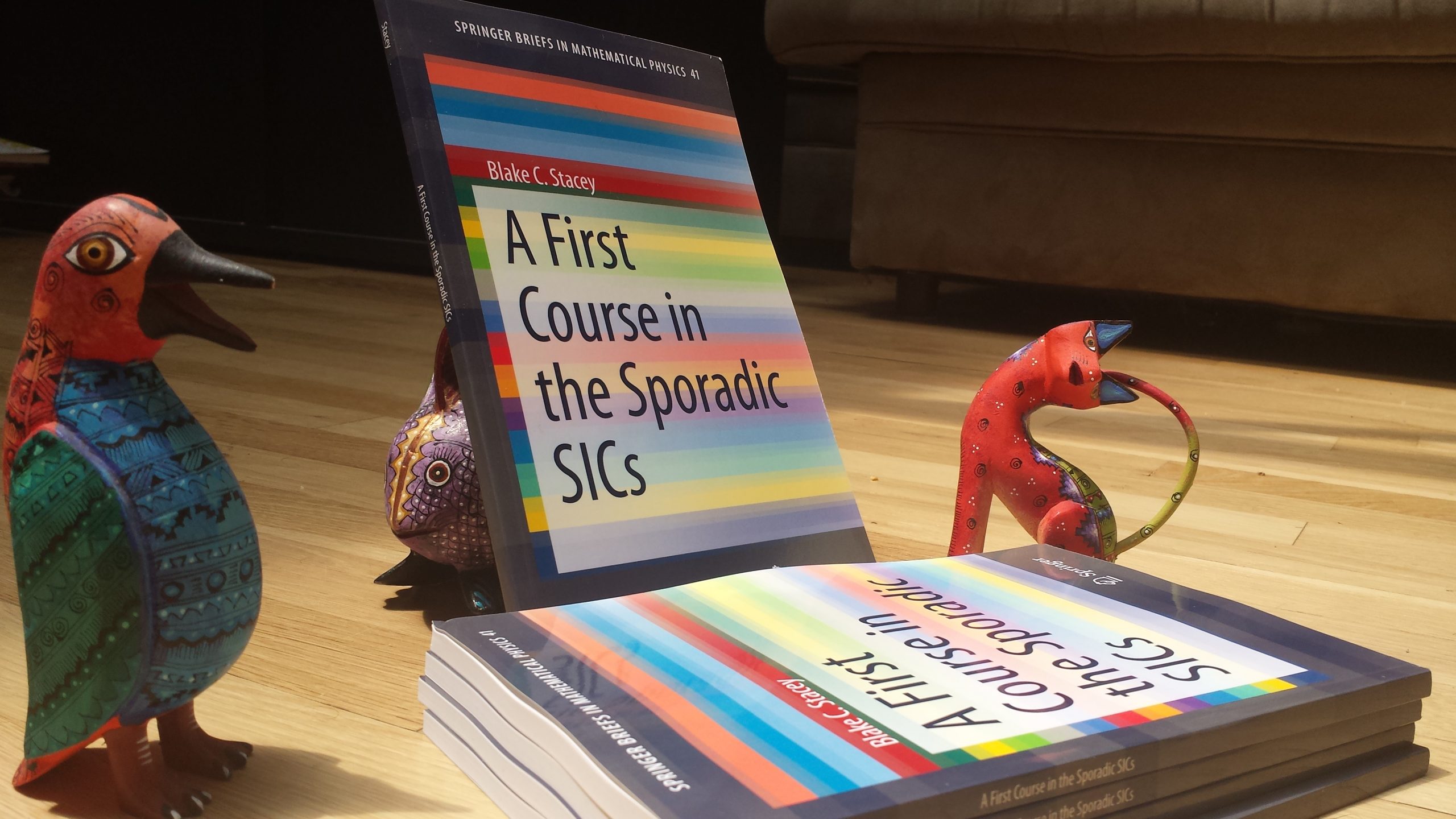
Copies of a textbook surrounded by Oaxacan carved wooden animals

B. C. Stacey, A First Course in the Sporadic SICs. SpringerBriefs in Mathematical Physics volume 41 (2021).

This book focuses on the Symmetric Informationally Complete quantum measurements (SICs) in dimensions 2 and 3, along with one set of SICs in dimension 8. These objects stand out in ways that have earned them the moniker of “sporadic SICs”. By some standards, they are more approachable than the other known SICs, while by others they are simply atypical. The author forays into quantum information theory using them as examples, and the author explores their connections with other exceptional objects like the Leech lattice and integral octonions. The sporadic SICs take readers from the classification of finite simple groups to Bell’s theorem and the discovery that “hidden variables” cannot explain away quantum uncertainty.

While no one department teaches every subject to which the sporadic SICs pertain, the topic is approachable without too much background knowledge. The book includes exercises suitable for an elective at the graduate or advanced undergraduate level.

ERRATA:

In the preface, on p. v, there is a puzzling appearance of “in references [77–80]”. This is due to an error in the process of splitting the book into chapters available for separate downloads. These references are arXiv:1301.3274, arXiv:1311.5253, arXiv:1612.07308 and arXiv:1705.03483.

Page 6: “5799” should be “5779” (76 squared plus 3), and M. Harrison should be added to the list of co-credited discoverers. The most current list of known solutions, exact and numerical, is to my knowledge this presentation by Grassl.

Page 19: “with equality if and only if both $\{R_i\}$ and $\{\sigma_i\}$ are SICs” should be “with equality if and only if both $\{R_i\}$ and $\{\sigma_i\}$ are the same SIC”. See arXiv:2312.11946 for a clarification by example.

Page 58: “Then there are 56 octavians” should be “Then there are 112 octavians”.

On the Writing Process

The problem I typically have when writing about technical topics is trying to include everything and to answer objections that seem vitally important to me but which don’t make much sense unless you’ve heard the debates inside my head. Removing that stuff has by now become a standard part of my revision process. My colleagues point it out, I feel a little hurt, then I grudgingly agree, and in a week or so I re-read my work and I don’t get why I thought that extra stuff was so important in the first place.

I’ve also noticed that the parts of an argument that people object to are often the bits that I thought were almost incidental, or that exist mostly in their head — they want to keep having the argument they’ve been having before. Trying to foresee how this will play out is hard, and it always helps to have input on that.

I count myself lucky to work with people who care about this kind of thing. I wish I’d had more training in my early years of physicist school — some harried lab reports and a single term paper don’t add up to much, honestly, given how much of our professional output is the written word.

What Would I Buy With $3 Million for Math[s]?

Leading off the topic of my previous post, I think it’s a good time to ask what we can do with resources that are already allocated. How can we fine-tune the application of resources already set aside for a certain purpose, and so achieve the best outcome in the current Situation?

This post will be a gentle fantasy, because sometimes, in the Situation, we need that, or because that’s all I can do today.

Last month, Evelyn Lamb asked, how should we revamp the Breakthrough Prize for mathematics? This is an award with $3 million attached, supported by tech billionaires. A common sentiment about such awards, a feeling that I happen to share, is that they go to people who have indeed accomplished good things, but on the whole it isn’t a good way to spend money. Picking one person out of a pool of roughly comparable candidates and elevating them above their peers doesn’t really advance the cause of mathematics, particularly when the winner already has a stable position. Lamb comments,

$\$3$ million a year could generously fund 30 postdoc years (or provide 10 3-year postdocs). I still think that wouldn’t be a terrible idea, especially as jobs in math are hard to come by for fresh PhD graduates. But […] more postdoc funding could just postpone the inevitable. Tenure track jobs are hard to come by in mathematics, and without more of them, the job crunch will still exist. Helping to create permanent tenured or tenure-track positions in math would ease up on the job crisis in math and, ideally, make more space for the many deserving people who want to do math in academia. […] from going to the websites of a few major public universities, it looks like it’s around $2.5 million to permanently endow a chair at that kind of institution.

I like the sound of this, but let’s not forget: If we have $3 million per year, then we don’t have to do the same thing every year! My own first thought was that if you can fund 10 postdocs for three years apiece, you can easily pay for 10 new open-source math textbooks. In rough figures, let us say that it takes about a year to write a textbook on material you know well. Then, the book has to be field-tested for at least a semester. To find errors in technical prose, you need to find people who don’t already know what it’s supposed to say, and have them work through the whole thing.

If we look at, say, what MIT expects of undergrad math majors, we can work up a list of courses:
Continue reading What Would I Buy With $3 Million for Math[s]?

Reaction GIFs are Useful

It’s pretty darn remarkable, really. Every time—every! smegging! time!—that Steven Pinker opens his yap and opines on something I know about, he comes across as a transparent buffoon. The topic could be modern research on evolutionary dynamics, or it could be fanfiction. Today, thanks to his participation in the annual Edge essay shindig, it’s the Second Law of Thermodynamics. Pinker’s essay is of the kind that starts semi-competently before going off the rails. He takes a valid and important scientific principle, oversimplifies painfully, discards all the actual content and ends up with a vacuous statement that shades into ethical irresponsibility.
Continue reading Reaction GIFs are Useful

Less Heteronormative Homework

A few weeks ago, I found an old physics book on a colleague’s “miscellaneous” shelf: University of Chicago Graduate Problems in Physics, by Cronin, Greenberg and Telegdi (Addison-Wesley, 1967). It looked like fun, so I started working through some of it.

Physics problems age irregularly. Topics fall out of vogue as the frontier of knowledge moves on, and sometimes, the cultural milieu of the time when the problem was written pokes through. Take the first problem in the “statistical physics” chapter. It begins, “A young man, who lives at location $A$ of the city street plan shown in the figure, walks daily to the home of his fiancee…”

No, no, no, that just won’t do any more. Let us set up the problem properly:

Asami is meeting Korra for lunch downtown. Korra is $E$ blocks east and $N$ blocks north of Asami, on the rectangular street grid of downtown Republic City. Because Asami is eager to meet Korra, her path never doubles back. That is, each move Asami takes must bring her closer to Korra on the street grid. How many different routes can Asami take to meet Korra?

Solution below the fold.
Continue reading Less Heteronormative Homework

Concerning “Great Books”

Shimer College: the worst school in America?

Subhead: This tiny, eccentric institution in Chicago was just voted the worst place to study in America. But does Shimer, which shuns lectures and has no societies or clubs, deserve such an accolade? Jon Ronson went there to investigate.

In the body, we have a bit more detail:

This is a ‘great books’ college. The great books of the western tradition, not the professors, are the teachers: Da Vinci’s Notebooks and Aristotle’s Poetics and Homer’s Odyssey and de Beauvoir’s Ethics of Ambiguity and Kafka and Derrida and Nietzsche and Freud and Marx and Machiavelli and Shakespeare and the Bible.

And:
Continue reading Concerning “Great Books”

Adventures in the Sophomoric

Yesternight, I went memory-road-tripping through my blog archives. One of the things I realized, apart from how amazingly enthusiastic I was for the blogging form back in 2007, was how much I reviled my sophomore-year university physics classes. At the time, they were unpleasant; in retrospect, they were deleterious.

The worst was the relativity class, which had most of the interesting stuff dug out, and hot air pumped in to fill it out to a semester. Also a waste of time was the first semester of quantum mechanics—we had three, and the latter two were great. That is actually a topic where a three-fold division could make sense. One could have, for example, a semester on the basic formalism, a semester on symmetries and exactly solvable systems and then a term covering approximation methods. But that’s not what we did. Instead, the first term was “intuition building,” which translates to “let’s plod through differential equations over and over and over again, because learning any oh-so-much-harder math would be too much for your young brains.” Mixed in with that was a rather bog-standard “physicist’s history of physics,” which was as usual too inevitably misleading to be worth bothering with. The time period in question is fascinating to me, as is our professional mythologizing about it. The textbook cardboard we got couldn’t do the subject justice.

And another thing: ditch the requirement of going to the Math Dept for a differential equations class. That class sucked. Again, pretty much inevitably. I’d say it was doomed from the get-go, i.e., failure was ensured by the choice of topics and level of coverage. (All I remember from that semester was the professor’s claim that the Laplace transform takes you into a world where everything is yellow. I still don’t know what that means. Everything I was supposed to learn in that class, I picked up elsewhere and elsewhen.) A much better alternative would be an in-house class on mathematical methods. It’d slot neatly into the same place in the curriculum, even. And there are good books to teach out of! Also, for the love of Gauss, don’t rely on Matlab. Real programming languages exist and are at least as easy to introduce. If you’re going to be gung-ho about Technologically Enhancing the Active Learning in your classrooms, you might as well teach some skills which physicists could actually use.

(Said in a tone of voice suggesting that one might eventually have dinosaurs on one’s dinosaur tour.)