
Category Archives: Pseudoscience

Behe on The Colbert Report

Last night, Michael Behe was Stephen Colbert’s guest on The Colbert Report. It was, shall we say, educational.

BEHE: Nobody was searching for the limits of Newton’s theory when Newton first proposed it. He thought that he had solved all of physics. But then when —

COLBERT: You mean about how — how apples fall?

BEHE: Apples fall, cannonballs go. But then —

COLBERT: Mm-hmmm.

BEHE: But then when —

COLBERT: He invented the cannonball? He invented the dive — the cannonball?

[audience laughs]

BEHE: Cannonballs fly.

Oh, yes. It’s nice to know that nobody checked to see if Newton was right, or if “universal gravitation” was really universal.

Wait. You say that it was Edmund Halley who used Newton’s laws to predict that comets travel in elliptical orbits, and that the comet seen in 1456, 1531, 1607 and 1682 would return in 1758? How could Halley say such a thing, after Newton had made his view clear that all comets travel in parabolic paths? It’s in the Principia, for Heaven’s sake! And you say that Halley was the one who realized that the stars are not fixed to a “celestial firmament” but instead move through space? How dare you imply that the views of one person are not the entirety of science! Sir, how dare you have the temerity to insist that people did not take Newton at his word but instead used his theories to make predictions about the world which they could then compare to observations to — I can hardly even articulate such a heretical notion — see if Newton was wrong.

What! Are you telling me it was the French, those wine-swilling, toad-munching surrender monkeys, who had the audacity to test Newton’s prediction that the Earth is an oblate spheroid? Sir, you could tell me all you want about the 1735 expeditions to Peru and Lapland under Charles-Marie de La Condamine and Pierre-Louis Moreau de Maupertuis respectively — the former of which incidentally brought back the first rubber and curare Europe had ever seen — but the mere suggestion that Newton’s word was not good enough is so repugnant I refuse to consider the matter further.

It gets better:
Continue reading Behe on The Colbert Report
Book Shelving as Social Commentary

Back in the days when postmodernism was almost new and you could still get a good riot at a political party convention, Jorge Luis Borges wrote, “In a modest, silent way, by arranging books on shelves, we ply the critic’s art.” Today, we have all the same literary experiences that previous generations enjoyed, but we do them harder, faster and longer — and perhaps with less silence and modesty, to boot. Most obviously, we “shelve” music and video with the same ease that Borges’ contemporaries arranged books. In our immodest, noisy way, we’ve all been music critics since about 1999.

Even before Napster and the MP3, we made mix tapes; long before multi-gigabyte hard drives, we had the drawer full of VHS cassettes. It’s just gotten easier, more global and more slick. More now, and less TwenCen.

Concomitant with all this has been another change. When, in the early years of the Barnes-and-Borders-a-Million, idle teenagers would move William S. Burroughs’ Naked Lunch (1959) to the “summer reading” section — because there was nothing else to do in Huntsville, Alabama — we (I mean, they) didn’t put up weblogs about the experience.
Continue reading Book Shelving as Social Commentary

Astrology Spam

I was just going through the ol’ Akismet spam bucket, and I noticed that my blag has recently started receiving astrology spam. First came the “Free Youtube Astrology Videos,” and then the “Free Daily Horoscopes.” Anybody else been seeing these?

It’s quite a combination: spam, an affront to basic courtesy, conjoined with astrology, an insult both to science and to human dignity. I mean, where’s the morality in judging a person by their star sign instead of who they are? Or, worse yet, in saying that those chance alignments of distant planets set limits on who we are, how our personalities can develop and what we can do. If you take it at all seriously, a claim like “Leos are dominant and aggressive but not verbally subtle” is less than a hair’s breadth from saying, “Well, he’s awfully articulate for a Leo, isn’t he?”

The only difference between the questions “What’s your sign?” and “Got any Negro blood in you, boy?” is the history of hatred attached to the latter, and the long timespan astrology has had to distance itself from the days when it was the propaganda tool of tyrants.

Incidentally, you gotta wonder what life would be like if entrail-reading had survived, and astrology had instead been the fortune-telling scam to fade away. Might we be having barroom conversations with lines like, “Why, I’m a pancreas too!” and reading daily newspaper columns about how gallbladders should look to spleens for love?

Vegetarian and vegan pagans might be having themselves a hard time, too. Or would the ceaseless efforts of human inventiveness yield a way to scry the future in a block of tofu?

The Creation Museum is Decadent and Depraved

You know, sometimes I regret having a workaday job in the hinterlands of academia (that is to say, two subway stops from MIT). It drastically reduces the quantity and variety of the shenanigans up to which I can get.

To wit, I could never fake a website to create the illusion of a news organization, assume the role of a man inflicted with “Asperger’s Syndrome by Proxy,” bluff my way into Ken Ham’s Creation “Museum” and write the whole thing up, gonzo-style.

Yes, there’s video:

“In the garden,” Ham said, looking over me into the filtering crowd, “you know, the Bible tells us in the garden before sin, in fact in the world before sin, all animals were vegetarian and so was Adam and Eve, and even though they have sharp teeth…”

“Why they have sharp teeth?” I interjected in my slow droning falsetto.

A cameraman, most likely from a local news outlet, rushed to Bunting’s left to film the inspiring exchange.

“Right. There’s a lot of animals that have sharp teeth, uh, that only eat plants,” Ham ruminated, “for instance most, most bears are primarily vegetarian, yet they have teeth like a lion or a tiger…”

“They eat fish!” I vehemently disagreed. “I saw it on the Discovery Chan-nel… but it’s sec-u-lar.”

“Some of them do,” Ham conceded, “but a panda eats only bamboo.”

The interview was going well. Ham was spouting nonsensical creationist rhetoric, and I was in full-blown retard mode. We were like long lost twins. He continued averting his gaze, however. My assumed detriments reminded him of man’s fall from grace. It was time to test this man of God.

Read the whole thing. . . and have a safe and happy Independence Day.

(We were somewhere outside Newton on the Mass Turnpike when the drugs began to take hold. I remember saying to Kevin and Mark, “I feel a little strange; maybe you should drive,” and suddenly the air was full of huge pterodactyls, swooping and diving around the yellow Datsun 240Z, and a voice was screaming, “Holy Jesus, what are these goddamn extinct animals?”. . . .)

Lagrangian Mechanics is Intelligent Design?

Via Kevin Beck I just learned that Sal Cordova, famous (in some circles) for rank dishonesty and general lack of mathematical aptitude, has been claiming that Lagrangian mechanics was inspired by Intelligent Design. For those who are not au courant with physics, Lagrangian mechanics is an alternative take on the classical physics — think billiard balls, pendulums, planets orbiting the Sun — studied by Newton. The enterprise is named for Joseph-Louis Lagrange, who along with Euler and others laid the groundwork. It’s equivalent to Newton’s F = ma approach, but more convenient for some problems, and because it talks about the same physics in a different way, it provides a different and useful starting point for developing new theories. (For example, Barton Zwiebach’s First Course in String Theory generalizes the Lagrangian description of zero-dimensional objects, particles, to invent a theory of one-dimensional objects, strings. This is much easier to do in a Lagrangian rather than a Newtonian formalism.) Phenomena in relativity and quantum field theory are also often studied via a Lagrangian approach.

Many people are familiar with basic characteristics of light. We know, for instance, that light travels in straight lines; when light bounces off a mirror, the angle of incidence equals the angle of reflection; light can be spread out or focused together using lenses; and so forth. When we study optics, we can derive all these disparate facts from a very simple, central premise: when traveling from point A to point B, a light ray takes that path for which the travel time is a minimum. (A more precise statement is that the physical path taken by the light ray is such that a small perturbation to the path does not significantly change the travel time; this is connected to the calculus idea that the slope of a curve at a minimum or maximum is zero. For our purposes, we won’t have to worry about these details.) If there’s nothing in the way to change the light’s propagation speed, or if the material through which the light travels is uniform, then the path of minimum time is a straight line. Requiring that the light go from A down to a mirror and bounce back up to B means — I leave the geometry as an easy exercise to the interested reader — that the angles of incidence and reflection will be equal.

Lagrangian mechanics takes a similar approach, taking the idea of a “minimum principle” and applying it not to light, but to the motion of matter — balls, planets, frightened cats and so forth. Instead of calculating the travel time, as we did with light, we consider the energy of the moving objects; more precisely, our calculations involve the difference between kinetic and potential energies. The “Lagrangian” for classical problems — remember, we can generalize the ideas later — is the difference between the kinetic energy and the potential, and we find the path through space an object will take by adding up, or integrating, the Lagrangian along all possible paths. The physical path, the one the object really follows, is the one whose total Lagrangian, or “action,” is a minimum.

Now, what in blazes does any of this have to do with Intelligent Design?
Continue reading Lagrangian Mechanics is Intelligent Design?

Carnivalia and Blagrolling

Can you believe we’ve made it through sixty-three editions of the Skeptic’s Circle without being struck by lightning, blighted with locusts or dobbsed with leprosy? Rejoice therefore!

One of the many notable entries in this fortnight’s Circle is Steven Novella’s piece on the purported autism-mercury link (hint, hint: there isn’t one, Robert F. Kennedy and Tom Tancredo not withstanding). Dr. Novella also has two good posts on Michael Egnor‘s recent torrid affair with dualism, so if you’d rather get your materialism fix from a Yale University neurologist instead of a physics buff who never learns to lay off the sriracha sauce, there you go.

I’d like to take this moment to give special thanks to all the people who have added Science After Sunclipse to their regular web-surfing experience. In particular, I’ve noticed this little site appearing on some blagrolls in very august company, which makes me happy indeed.

Michael Egnor and Spiritual Pay-Per-View

The weight of evidence, gathered over at least two and a half millennia, indicates that the mind is a product of the brain. Some people find this notion disquieting, and consequently they marshal various arguments to try and dispel the unpleasant conclusion. I haven’t done a quantitative study on which sophistries are the most common, but I have the strong impression that this one is widely used: the soul isn’t “in” the brain, the denier says, any more than television programs are “in” the TV antenna.

This argument would be a whole lot more convincing if damage to different parts of the brain didn’t have different effects, and if imaging of brain activity didn’t show that particular activities and even modes of thought manifest themselves in different, characteristic parts of the nervous system. We’d have to be tuned to a whole premium package of Soul TV channels, each received by its own wet antenna, and each broadcast by its own Ethereal Broadcasting Company — a whole industry of Spiritual Pay-per-View!

The latest devotee of this dubious proposition is — almost inevitably — Michael Egnor.
Continue reading Michael Egnor and Spiritual Pay-Per-View

Bug Girl on DDT-Resistant Mosquitoes

If the idea of vampire bugs wasn’t frightening enough, how about vampire bugs which are immune to fire, silver and garlic?

That’s the story Bug Girl tells in her latest installment, “DDT, Junk Science, Malaria, and insecticide resistance.” It’s a clear display of Darwin at work, which anybody who has experienced a midsummer night in Alabama can appreciate.

This installment follows last week’s piece, which debunked the recent attacks on Rachel Carson.

Oh No, Not Again

Dammit, Warren, we don’t need you spreading pseudoscience along with everybody else. The Heim theory “spacedrive” is a total crock. Remember, this is the nonsense which John Baez called “a run-of-the-mill crackpot theory” and of which Sean Carroll said,

Just so nobody gets too excited — this paper is complete nonsense, not worth spending a minute’s time on. If I find the energy I might post on it, but this is no better than the other hundred crackpot preprints I get in the mail every year.

For details, you can start here and here. It looks like I might have to dig that post out of my “drafts” pile after all. . . .

New Scientist has a lot to answer for.

More on Behe’s The Edge of Evolution

The list of reviews and follow-ups to reviews continues to grow. The reality-based community has not been kind to Michael Behe’s The Edge of Evolution, and they’re expressing their reasons why with wit and verve.

The latest addition to the list comes from Jerry Coyne, professor at the University of Chicago. Entitled “The Great Mutator,” a free copy can be found here. I quote the final three paragraphs below the fold, with some added links for the folks who like extra reading.
Continue reading More on Behe’s The Edge of Evolution

Quick Post: Voices on the Net

Whoo! The Powers That Be keep inventing deadlines for me, so I will feed the blagobeast with a quick, quote-heavy post. Mark Chu-Carroll’s review of Behe’s The Edge of Evolution has attracted the attention of some creationist trolls, and some of the responses have been both memorable and pithy.

A mysterious being known only as Xanthir, FCD said the following:

As Mark implied, the distinction between micro- and macro-evolution is artificial and false. It amounts to drawing a line in the sand and saying, “Evolution can change things this much, but no further.” It says this without any reason why evolution wouldn’t be able to go past that point, and what’s more flies directly in the face of reams of actual data. It’s basically akin to splitting math into micro- and macro-arithmetic, and saying that numbers greater than a billion are part of macro-arithmetic and don’t occur through natural counting processes, and thus things that involve numbers past that line must have been created whole rather than building up from smaller quantities. The problem with that, of course, is that you can always add 1. Same thing here — you can always add one more mutation.

If you prefer the point made by early-1990s music video, see my earlier post, “Square One on Infinity” (and don’t say I didn’t warn you).

For the standard TalkOrigins critiques of the creationist micro/macro ploy, see here and here.

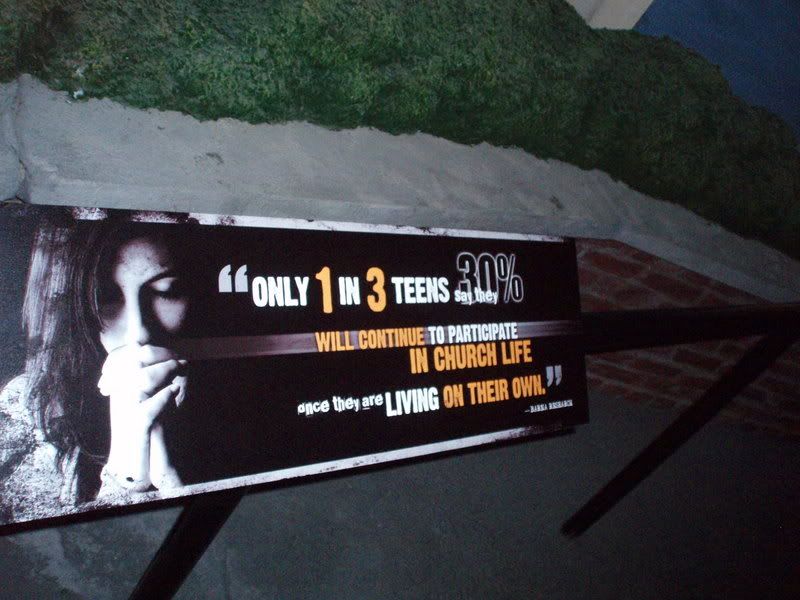
1 / 3 = 30%

OK, there’s so much to pick on in the Creation “Museum” that it constitutes a classic “target-rich environment,” but one of Media Czech’s photos is just too good to pass up:

Click to enlarge

First, I think rounding off to one significant figure represents a great advance for creationist mathematics. Dividing 1 by 3 to get 30% is a big improvement over their other, ahem, arithmetic issues (insisting on 6,000 when the actual figure is 13.7 billion, for example). Second. . . .
Continue reading 1 / 3 = 30%