Category Archives: Pseudoscience

Quoting a Motl

Among other things, that when you talk to string theorists in person, they’re much more open-minded and reasonable than you’d expect! Of course, when your de facto spokesman is the self-parodying Luboš Motl — who often manages to excoriate feminists, climatologists, and loop quantum gravity theorists in the very same sentence — it’s hard not to seem reasonable by comparison.

— Scott Aaronson (21 December 2006)

If you inhabit the same corner of the Network that I do (and you’re reading this right now, so that seems likely) you’ve probably heard about NASA Administrator Mike Griffin’s intemperate remarks about global warming. (For a refresher, see the dependable Phil Plait.)

Via Tim Lambert, I hear that a denialist “press release” collects some approving comments from the usual suspects. Apparently, the “Science and Public Policy Institute” saved the best quote for last:
Continue reading Quoting a Motl

Behe’s Bad Arithmetic and Worse Science

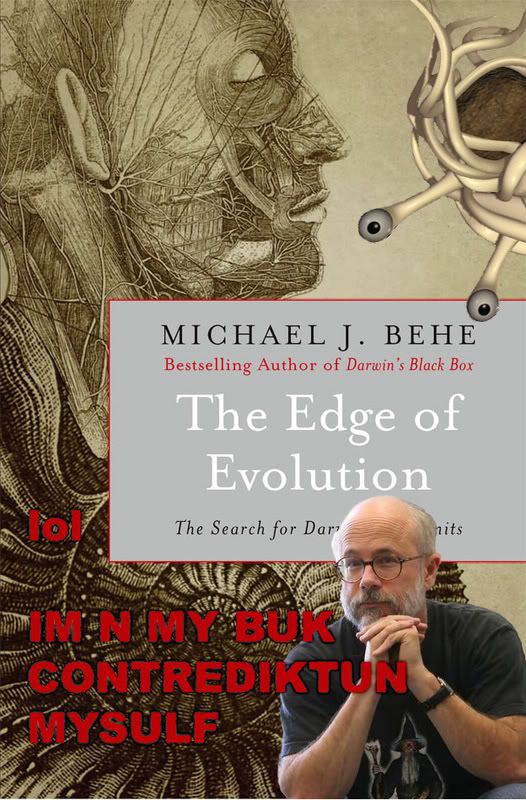
Blogging on Peer-Reviewed ResearchI would like to celebrate the official release date of Michael Behe’s new book, The Edge of Evolution, by pointing out a grotesque factual error in its very heart.

A major theme, if not the major theme, of Behe’s diatribe is the disease known as malaria. He wants to prove that evolution by natural means of any but the most trivial features of living things is completely impossible, and he uses the parasites which cause malaria as his test case. Unfortunately for him, but happily for the decades of scientific discovery which he tries to condemn, the mistakes in his argument tear it asunder.

Since Behe’s argument is built upon malaria, and in particular the evolution of the parasite Plasmodium falciparum to be resistant to the drug chloroquine, we should look at what modern biology has learned about how chloroquine resistance evolved. As chloroquine was “the best and most affordable antimalarial drug” in the history of antimalarial drugs, the evolution of resistance to it — and the spread of that resistance throughout the world — poses a real problem, which scientists are naturally eager to investigate.
Continue reading Behe’s Bad Arithmetic and Worse Science

Egnor, Farrell and Lemaître

I don’t want Science After Sunclipse to become, in Orac’s words, “All Egnor, all the time,” but after my recent intemperate remarks about Egnor’s misguided dualism, I figure I should follow with a link to John Farrell’s rebuttal to Egnor’s cosmology.

Following up on his insistence that science is always seeking to confirm the “design inference,” Egnor says this about Georges Lemaître, the first scientist to conceive of the Horrendous Space Kablooie:

Ironically, we owe much of our modern understanding of the universe to pro-intelligent design astronomers. Georges Lemaître was the astrophysicst who pioneered the Big Bang Theory. Fr. Lemaître (above, with Einstein) was a Belgian Roman Catholic priest, honorary prelate, and a professor of physics and astronomy. He famously described the moment of the Big Bang as “the day without yesterday”, referring to the first day of creation in Genesis, and he was explicit in his belief in the evidence for God’s design in the universe. His Big Bang theory met with considerable opposition because of its religious implications.

Farrell observes, “First, Lemaître was not referring to the day without yesterday as the first day of creation in Genesis. I’m sure it will surprise no one that Mr. Egnor offers no quotes to support his contention.” In fact, Lemaître stated the following at the 1958 Solvay conference:

As far as I can see, such a theory remains entirely outside any metaphysical or religious question. It leaves the materialist free to deny any transcendental Being. He may keep, for the bottom of space-time, the same attitude of mind he has been able to adopt for events occurring in non-singular places in space-time. For the believer, it removes any attempt at familiarity with God, as were Laplace’s chiquenaude or Jean’s finger. It is consonant with the wording of Isaias speaking of the “Hidden God”, hidden even in the beginning of creation. . . . Science has not to surrender in face of the Universe and when Pascal tries to infer the existence of God from the supposed infinitude of Nature, we may think that he is looking in the wrong direction.

Farrell goes on at slightly greater length, but I believe the point has been made.

Michael Egnor: 2400 Years Behind the Times

BPSDBI nearly sprayed my breakfast across my friend’s new flatscreen monitor when I saw the latest from Michael Egnor:

Clearly the brain, as a material substance, causes movement of the body, which is also a material substance. The links are nerves and muscles. But there is no material link between our ideas and our brains, because ideas aren’t material.

Mr. Spock, are your sensors detecting any signs of intelligent life?
Continue reading Michael Egnor: 2400 Years Behind the Times

PZ Myers on the Quantum Mind

This one is worth repeating:

Quantum effects in microtubules are going to be inconsequential relative to ion fluxes and chemical changes in membrane properties and channels, and there is no explained mechanism to regulate quantum effects. It’s like trying to explain the tides by speculating about the dabbling of gnats in estuaries.

The people who talk about this stuff usually seem to have absolutely no knowledge of neuroscience.

For sheer disdain, this might be second only to Patricia S. Churchland‘s remark, “The want of directly relevant data is frustrating enough, but the explanatory vacuum is catastrophic. Pixie dust in the synapses is about as explanatorily powerful as quantum coherence in the microtubules.”

My most extensive essay on this subject can be found here, and a good paper with many references into the literature is A. Litt et al.,Is the Brain a Quantum Computer?” (Cognitive Science, 2006).

Chu-Carroll on Behe’s The Edge of Evolution

Dear Gentle Readers: At the bottom of this essay, I’m collecting links to reviews of Behe’s book The Edge of Evolution, replies to reviews and so forth.

Well, now the burden is off me, and I can devote my book-reviewing time to good books, like the works of Hector Avalos. Mark Chu-Carroll has reviewed Michael Behe’s new book, The Edge of Evolution. In short, it’s as bad as I thought it would be. When I first heard about it, the only information available was the flap copy: the publisher’s blurb and four laudatory quotes. I found that with a trivial amount of Web-searching, each laudator was revealed to be a creationist sympathizer — which didn’t bode well for the contents of the book itself. What, they couldn’t get even one serious biologist to say something good about it?

My prediction, although in principle falsifiable, was not falsified but instead borne out by further investigation. Don’t you love it when that happens?

Behe’s new book comes at an interesting time in the ongoing struggle against arrogant ignorance. Once upon a time, the law mandated that Genesis be taught in science classrooms; then came “equal time” for science and mystical anti-science, followed by “creationism” and “creation science” which then became “Intelligent Design,” about which we had to “teach the controversy.” (Of course, like a linear portrayal of biological evolution, this little “X followed by Y” story focuses only on one path, on a single twig of a ceaselessly diversifying bush. Just as there are still living descendants of the dinosaurs, there are still Old Earth Creationists, ideological descendants occupying their own branch of the phylomemetic tree.) After the thumping “Intelligent Design” got at Dover, many of us wondered how the opposition to reason would reinvent itself. One strategy, embraced by at least one twig, is to rebrand the very word evolution:
Continue reading Chu-Carroll on Behe’s The Edge of Evolution

The Physics of Bronze Age Mythology

Normally, when one sees a book title of the form The Physics of Imaginary Thing X, the implication is that X (Star Trek, superheroes, the Buffyverse, etc.) is being compared to the real world in order to illuminate how the real world works in a fun and memorable way. What would it take for warp drive to work, and how much energy is required to o’erleap a tall building in a single bound? If, as they often are, the movies are horribly wrong, can we use that wrongness to explain what is right?

Plenty of possible titles exist for future works in the same genre, but it looks like Frank Tipler has taken the matzo with his latest:

The Physics of Christianity.
Continue reading The Physics of Bronze Age Mythology

Perakh on Barr: Rejoicing in Materialism

Via the Panda’s Thumb comes notice of Mark Perakh’s review of Stephen M. Barr’s Modern Physics and Ancient Faith (2003). I recommend reading the whole review; Perakh demonstrates that Barr’s book, like Ken Miller’s Finding Darwin’s God (1999), offers some lucid descriptions of modern science but devolves into poor reasoning and non sequiturs when it touches notions of faith.

None of Barr’s arguments or Perakh’s counter-arguments are particularly new (which is one sign of how decrepit a business this “natural theology” really is). Barr organizes his book by describing successive “plot twists,” discoveries which supposedly upset the tidy materialism of a century ago. You could guess that quantum mechanics figures prominently; a couple linear operators fail to commute, and people run around saying reality’s been undone. Kurt Gödel also makes an appearance:
Continue reading Perakh on Barr: Rejoicing in Materialism

Creation “Science” “Museum”

Well, yet another monument to human stupidity has opened its doors to the paying public. It reminds me of the Mencken character in Inherit the Wind: “Darwin was wrong — man is still an ape, and his creed is still a totem pole.”
Modified newspaper front page

Ken Ham’s Creation Museum has provoked the reality-based community to put fingers to keys. PZ Myers has collected their writings, providing a long, long list of links and excerpts. The National Center for Science Education has also collected reactions to Ken Ham’s museum.

Funnily enough, I just picked up a paperback copy of Neil Gaiman’s American Gods (2001), from a friend who’s jettisoning her fiction before moving to California, sunny land of graduate schools. In this novel, Gaiman presents his own theory of American roadside attractions:
Continue reading Creation “Science” “Museum”

Framing is Back

Framing is back. Sheril Kirshenbaum is writing guest posts over at Chris Mooney’s place (1, 2 and 3 so far). In her first three posts, she’s talking sense, though her writing isn’t exactly rocking my geological column.

(That sounds a little dirtier than I intended. Ah, well, I’m not an old fossil yet.)

The interesting thing is that nothing of what Kirshenbaum has written involves deep anthropological foundations. You could have said exactly the same things before the framing kerfluffle and with no knowledge of Lakoffian whosiewhatsits. Now that the subject has been called back to my mind, I think I can offer an executive summary of what bothers me about the whole “framing” business.
Continue reading Framing is Back

Dear Michael Shermer: Physics Matters

Dear Gentle Reader: if you have discovered this post by searching for a phrase like “positive thoughts more powerful than negative thoughts,” it is my duty to tell you that no, they aren’t.

I just spotted (via Mind Hacks and my spiffy new RSS reader) Michael Shermer’s article in the June 2007 Scientific American,The (Other) Secret.” While I appreciate anything which applies the cluestick to pseudoscientific bunk, I’m afraid Shermer needs a bit of a refresher course himself. I quote from a little way into the column:

A pantheon of shiny, happy people assures viewers that The Secret is grounded in science: “It has been proven scientifically that a positive thought is hundreds of times more powerful than a negative thought.” No, it hasn’t. “Our physiology creates disease to give us feedback, to let us know we have an imbalanced perspective, and we’re not loving and we’re not grateful.” Those ungrateful cancer patients.

So far, pretty good. We continue:

“You’ve got enough power in your body to illuminate a whole city for nearly a week.” Sure, if you convert your body’s hydrogen into energy through nuclear fission. “Thoughts are sending out that magnetic signal that is drawing the parallel back to you.” But in magnets, opposites attract—positive is attracted to negative.

Aaagh! Double aaagh!
Continue reading Dear Michael Shermer: Physics Matters

The Unapologetic Mathematician on Popularization

John Armstrong has a short and sweet post on popularizing mathematics and physics which is worth reading in its entirety. I don’t want to quote the whole thing, so just go read it.

Incidentally, he says he was inspired to write the post by the movie Mindwalk (1990). I had only ever heard of this flick because they’d stuck a preview for it on the Brief History of Time video I rented sometime in the late nineties. I then managed to forget about it until a few weeks ago, when I was poking through Wikipedia for articles containing pseudoscience. Somehow, in the tangled thicket of pages growing like weeds upon quantum mysticism and Choprawoo, I found Mindwalk. “Aha! I remember seeing a preview for that movie.”

Tancredo Endorses Antiscience

Joel Achenbach writes in yesterday’s WaPo magazine about “retail politics” and the presidential campaign which is happening in the wrong year. Towards the end, he describes what happened when he tagged along with Tom Tancredo:

One day in Keene, N.H., I tagged along with Tom Tancredo as he went from table to table in Lindy’s Diner. Tancredo is a Colorado Republican with a hard line on immigration. He said he needed to raise $1 million in the first three months of the year. Wasn’t sure he could do it. Hardly anyone knows who he is.

“Hi, I’m Tom Tancredo,” he would say at each table. Most people had no idea who he was, and he seemed a bit reluctant to utter the obvious phrase, “and I’m running for president.”

A woman asked Tancredo, “What do you think of autism in this country?” She has a 4-year-old with autism. Tancredo said, “I think much of it is due to the number of shots we give to kids . . .” They talked about mercury in vaccines’ preservatives. She was impressed by Tancredo — but she’s a Democrat. Retail has its limitations.

Left and right united against medicine! Why, Tancredo could have Robert F. Kennedy, Jr. as his running mate. Denial of fact should not be the basis for politics, people.
Continue reading Tancredo Endorses Antiscience