Henry V, Act 4, Scene 1

But if the cause be not good, the king himself hath
a heavy reckoning to make, when all those legs and
arms and heads, chopped off in battle, shall join
together at the latter day and cry all 'We died at
such a place;' some swearing, some crying for a
surgeon, some upon their wives left poor behind
them, some upon the debts they owe, some upon their
children rawly left. I am afeard there are few die
well that die in a battle; for how can they
charitably dispose of any thing, when blood is their
argument? Now, if these men do not die well, it
will be a black matter for the king that led them to
it; whom to disobey were against all proportion of
subjection.

(Source.)

Software Quirk of the Day

Suppose you want to know the skewness of a list of numbers, and luckily enough you have Python close at hand. The skew() function in the SciPy stats library returns a single-element array instead of a floating-point number. Why, I have no idea, but at least the developers seem to know about it. Trying to get the value out by a sensible method like, say, indexing the array returns the error message “0-d arrays can’t be indexed.” To get the value itself, subtract 0:

result = scipy.stats.skew(list_of_values) - 0

Just one more way life has found to make itself interesting.

My Cheap Shot of the Day

This is the Archbishop of Canterbury trying (and failing) to speak about science:

Dr Williams admitted that Neo Darwinism, a theory supported by Atheist Professor Richard Dawkins, is “most problematic” to theology, but he called it “a pseudo science” and “deeply vulnerable to intellectual challenge because it is trying to be a theology.”

And here I thought Richard Dawkins’s professorship was endowed by Charles Simonyi, not Bob Atheist!

News for Those Still Content

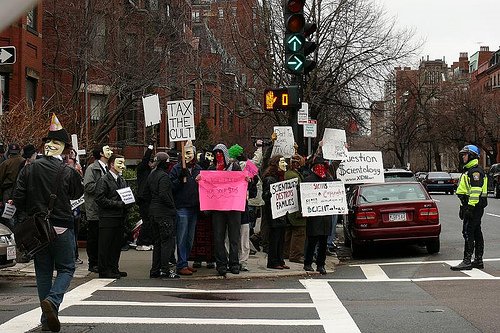
laughing_anon.pngRebecca Watson wonders why the big news media aren’t covering the Anonymous protests of Scientology which occurred this past weekend, and she notes that the next event, “Operation Reconnect,” will occur the twelfth of April. On the good chance that you won’t be able to see it on TV or read about it in your daily paper, your best bet to find out what’s going on might be to don a mask and attend in person.

Next, Jacques Distler takes a quantitative look at which political party here in Etats-Unisia has really been “the party of business.” Yes, Virginia, claims can diverge from reality now and then — and to drive that point home, check out Steve Novella‘s description of a recent case where uncritical acceptance of “facilitated communication” caused a Colorado family great and completely unnecessary suffering.

Two Slashdottings In One House

I got a little blip of a Slashdotting when I wrote about the Stuart Pivar incident, but my friend Brian Neltner — expert in genetically engineering viruses to his bidding, and black belt in a martial art which teaches eyeball extraction as a standard “defensive” move — has got the real deal. He designs LED artwork, you see, incorporating UV lights and other extra goodies to create colors which can’t be captured in a camera or reproduced on a computer screen. Imagine a room bathed in smoothly shifting wavelengths of vivid color, changing the appearance of everything they touch as pigments vanish or merge only to arise again in new, deceptive patterns.

That’s our living room.

The total effect of these LED fixtures is a combination of both additive and subtractive color mixing. Oh, and if you look directly at the UV LEDs without the protective diffuser screen installed, well, you better not look again with your remaining eye. Normal people, when we tell them this, back away, but for some reason, MIT students always need to check for themselves.

What do you do with an Ultraluminous Illuminator of Doom? Well, you shine it on artwork! Brian and his mother Janet went to great lengths to find pigments which work well under polychromatic precision light:
Continue reading Two Slashdottings In One House

SUSY QM: The 1D Dirac Hamiltonian

Whew! We spent a considerable amount of wordage developing the Dirac Equation. Now, it’s time to tie this development back to the supersymmetry material we studied earlier in the non-relativistic context. The result will be a surprising mapping between relativistic and non-relativistic quantum mechanics. Today, we’ll just get the gist of it, and to get started, we’ll begin with the final equation we had before,

[tex](i\displaystyle{\not} \partial – m)\psi = 0.[/tex]

Recalling Feynman’s notation of slashed quantities,

[tex]\displaystyle{\not} a = \gamma^\mu a_\mu,[/tex]

we can unpack this a little to

[tex]\left(i\gamma^\mu\partial_\mu – m\right) \psi = 0,[/tex]

which we can elaborate to include an electromagnetic field as follows:

[tex]{\left[i\gamma^\mu(\partial_\mu + iA_\mu) – m\right] \psi = 0.[/tex]

The Dirac Hamiltonian [tex]H_D[/tex] has a rich SUSY structure, of which we can catch a glimpse even having pared the problem down to its barest essentials. To take the simplest possible case, consider a Dirac particle living in one spatial dimension, on which there also lives a scalar potential [tex]\phi(x^1)[/tex]. (We could call this a “1+1-dimensional” system, to remind ourselves of the difference between time and space.) The SUSY structure can be seen most clearly when we look at the limit of a massless particle; this eliminates the [tex]m[/tex] term we had before.
Continue reading SUSY QM: The 1D Dirac Hamiltonian

Hacked

I think my site has been hacked.

The IP responsible is 58.65.236.89.

All sorts of stupid crap is appearing in my WordPress pages. Please hold while we resolve the difficulty and beat up the people responsible.

UPDATE (2:39 AM): I think the damage has been un-done. While for about thirty seconds I was panicked and a little flattered that I might finally have pissed off somebody important, it looks like it was just a script kiddie from Hong Kong. Now, I just need to see how it happened and how I can stop it from happening again.

UPDATE (3:29 AM): Well, the good news is, it doesn’t look like the problem is my fault. In fact, I’m rather expecting that every PHP and HTML file hosted on SiteGround has been tagged with two extra lines of code.
Continue reading Hacked

Intermezzo: The Dirac Equation

After you’ve been Pharyngulated a couple times, you develop a protective strategy to deal with the aftermath. “How,” you ask yourself, “can I get rid of the extra readers whom I’ve probably picked up?” The answer, for me at least, is clear:

Math!

RECAP

Science After Sunclipse has been presenting an introduction to supersymmetric quantum mechanics. This area of inquiry stemmed from attempts to understand the complicated implications of supersymmetry in a simpler setting than quantum field theory; just as supersymmetry began in string theory and developed into its own “thing,” so too has this offshoot become interesting in its own right. In a five-part series, we’ve seen how the ideas of “SUSY QM” can be applied to practical ends, such as understanding the quantum properties of the hydrogen atom. I have attempted to make these essays accessible to undergraduate physics students in their first or possibly second term of quantum theory. Having undergraduates solve the hydrogen atom in this fashion is rather unorthodox, but this is a safe kind of iconoclasm, as it was endorsed by three of my professors.

The posts in this series to date are as follows:

Having solved the “Coulomb problem,” we have attained a plateau and can move in several directions. The solution technique of shape-invariant partner potentials is broadly applicable; virtually all potentials for which introductory quantum classes solve the Schrödinger Equation can be brought into this framework. We can also move into new conceptual territory, connecting these ideas from quantum physics to statistical mechanics, for example, or moving from the non-relativistic regime we’ve studied so far into the territory of relativity. Today, we’ll take the latter route.

We’re going to step aside for a brief interlude on the Dirac Equation. Using some intuition about special relativity, we’re going to betray our Vulcan heritage and take a guess — an inspired guess, as it happens — one sufficiently inspired that I strongly doubt I could make it myself. Fortunately, Dirac made it for us. After reliving this great moment in TwenCen physics, we’ll be in an excellent position to explore another aspect of SUSY QM.

REFRESHER ON RELATIVITY

Let’s ground ourselves with the basic principles of special relativity. (Recently, Skulls in the Stars covered the history of the subject.) First, we have that the laws of physics will appear the same in all inertial frames: if Joe and Moe are floating past each other in deep space, Joe can do experiments with springs and whirligigs and beams of light to deduce physical laws, and Moe — who Joe thinks is moving past with constant velocity — will deduce the same physical laws. Thus, neither Joe nor Moe can determine who is “really moving” and who is “really standing still.”

Second, all observers will measure the same speed of light. In terms of a space-time diagram, where time is conventionally drawn as the vertical axis and space as the horizontal, Joe and Moe will both represent the progress of a light flash as a diagonal line with the same slope. (This video has some spiffy CG renditions of the concept.) To make life easy on ourselves, we say that this line has a slope of 1, and is thus drawn at a 45-degree angle from the horizontal. This means we’re measuring distance and time in the same units, a meter of time being how long it takes light to travel one meter.
Continue reading Intermezzo: The Dirac Equation

Your Funny for Today

This one comes from Ellen Wulfhorst on the Reuters wire:

Unlike traditional, mainstream media, blogs often adopt a specific point of view. Critics complain they can contain unchecked facts, are poorly edited and use unreliable sources.

I sense a great disturbance in the Schwartz, as if a million monitors were just sprayed with soda. (Well, no, I don’t have that many readers, but Dave Neiwert, Athenae and Coturnix have already picked up on it.) And here’s another puzzling statement from the same piece, describing the poll which found that “a majority of Americans do not read political blogs.”

The poll was conducted online from January 15 to January 22 among 2,302 adults. Harris said it does not calculate or provide a margin of error because it finds such figures can be misleading.

Is anyone else concerned by the sampling bias which this procedure could entail? If you ask people online what websites they read, you’re going to get (at best) a measure of what people who spend time online read, not what Americans in general are reading. Sure, that’ll probably increase the percentage of blog readers, skewing the poll towards “new media,” but it’s still bias. (They claim to have used “propensity score weighting” to “adjust” for this.)

On their website, Harris Interactive lays out their rationale for not reporting margins of error. Basically, they assert that people are too poorly educated to know what “margin of error” means: people don’t know that the phrase refers only to sampling error, not to other possible sources of obfuscation (which are harder to get a quantitative handle on). Therefore, people will assume that polls are more accurate than they really are; to avoid this problem, and to save the wear-and-tear on a newscaster’s mouth which the tediously long phrase “margin of sampling error” would produce, Harris will not admit fallibility at all.

Gee, how nice of them to make that decision for us, so that even the people who know statistics can’t get the figures. I just loooove suffering for the sins of innumerate America.

UPDATE: I also get a kick out of this:

Just one in ten (19%) Echo Boomers (those aged 18-31) regularly read a political blog

One in ten. Nineteen percent. Oops.

I Know Link-Fu

I have more things to write about than time to write them in. Hooray!

So, whilst I vainly strive to catch up with a few of my goals, what are other people on the Network doing these days?

First, Happy Jihad’s House of Pancakes hosts the 82nd Skeptic’s Circle.

Then, Martin Rundkvist discovers what a Wikipedian edit war is like, the poor fellow. Which reminds me: one of my ideas for a semi-regular feature I want to try on this blag is a “Friday Wikipedia Woo” series. The “Human Design System” article I wrote about before has been deleted, but sadly, there’s always plenty more where that came from. (If you want to hunt for it yourself, I suggest starting with what links to the “quantum” page.) Give people a free encyclopedia they can edit themselves, and you’ll wake up to find it’s been turned into an advertising service. Sigh.

Elsewhere, Russell Blackford has spelled out his own version of Dawkins’s “Ultimate 747” gambit. Go forth and discuss! Talking of “gambits” naturally makes me think about chess. “White opened with the Blackford Variation on the Dawkins 747. . . .” Maybe chess fiend Jason Rosenhouse can extend the analogy further — recently, he’s put up a couple interesting posts, too.

Meanwhile, a review of Michael Shermer’s new book, The Mind of the Market (2008), prompted Tyler DiPietro to say a few words of his own. Expect more from that quarter in the future (and hang around for a bonus rant of mine in the comments).

Brian Switek has been keeping up an astonishing output, on tapirs and monkeys and hermit crabs, among other things. And then Abbie describes how some viruses which infect bacteria carry genes which the viruses themselves don’t need, but which are helpful to the bacteria they infect.

Life is pretty ^%$)(&@ weird, isn’t it? Fortunately, Masala Skeptic has a few appropriate swear words to use when it all gets too much.

Poll: What’s Broken?

It occurs to me that I need a book I don’t have at hand right now in order to finish the post I had hoped to complete today, so in lieu of something which requires actual work on my part, I’ll pose a question to my Gentle Readers. By reading this now, you’re kind of by definition a “person who reads science blogs,” and most likely you read others besides mine; many of you might have homes of your own on the Interblag. I figure, then, that the people passing through here have perspectives from both sides, producer and consumer (a division we often try our darndest to narrow). So, then:

If you could fix one thing about the science-blogging experience, what would it be?

Aaronson on Turing, Gödel and Searle

Computer-science guru Scott Aaronson has begun to put lecture notes for his “Great Ideas In Theoretical Computer Science” course online. (That’s 6.080 in MIT-speak: words are for the weak.) Prepared by the students and edited by the instructors, the notes are terse but clear and enjoyable. I particularly like lecture 6, “Minds and Machines,” of which the following is a taste:

We already established that no Turing Machine exists can solve the halting problem. If we had a proof system that could analyze any Turing machine and prove if it halted or did not halt, we could use this system to solve the halting problem by brute force (also known as the “British Museum algorithm”) by trying every possible string that might be a proof. You would either terminate and find a proof that it halts or terminate and find a proof that it doesn’t halt. If this proof system was sound and complete, it would violate the unsolvability of the halting problem. Therefore, there is no such sound and complete proof system.

I also like this bit:
Continue reading Aaronson on Turing, Gödel and Searle

"no matter how gifted, you alone cannot change the world"