
Xiaojuan Sun, Matjaz Perc, Qishao Lu, and Jürgen Kurths, “Spatial coherence resonance on diffusive and small-world networks of Hodgkin-Huxley neurons” (arXiv:0803.0070, accepted for publication in Chaos).
Continue reading Currently Reading
Physics on the Brain, Part 1
 Can physics tell us about ourselves?
To phrase the question more narrowly: can the statistical tools which physicists have developed to understand the collective motion of large agglutinations of particles help us figure out what our brains are doing?
If Jack Cowan and his colleagues are correct, ideas from statistical physics can tell us important facts about our own brains. By studying the recurring motifs of hallucinations, we can construct a geometry of the mind.
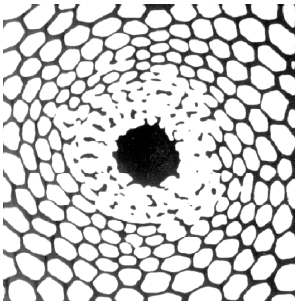
“Honeycomb” form constant,
from Bresloff, Cowan et al. (2002)It’s hard to imagine any sort of regularity in a phenomenon as eccentric as visual hallucinations. Our culture is brimming with psychedelia, music and art produced “under the influence” of one or another infamous chemical. Yet the very fact that we can label artwork as “psychedelic” suggests that the effects of those mind-bending substances have a certain predictability. In the 1920s, long before the days of review boards and modern regulations for human experimentation, the neurologist Heinrich Klüwer ingested mescaline and recorded his observations. He reported visual hallucinations of four distinct types, which he called “form constants.” These form constants included tunnels and funnels, spirals, honeycomb-like lattices and cobweb patterns. Similar structures have been reported with other drugs, like LSD; these same form constants also appear during migraines, in “hypnogogic” (falling asleep) and “hypnopompic” (waking up) states, when pressure is applied to closed eyes, and even in ancient cave paintings.
If the same hallucinatory images appear from many causes, might they be indicative of some more general property of brain structure?
Continue reading Physics on the Brain, Part 1
Happy Birthday, PZ
We’ve broken our fast with him when he passed through our town, and we’ve honored him in his absence. Now, it’s time to wish a certain evilutionary superscientist a happy fifty-first birthday:

I didn’t have my own blag the last time we fêted PZ Myers, but I did join the others in writing a poem:
Continue reading Happy Birthday, PZ
Filler Art
A whole heap of stuff has to get written in the next week. Some of it I’m getting paid for; all of it is overdue. I think it’s time to take a vacation from the Internet, or at the very least, from the comment threads of science blogs. Don’t trash up the place while I’m away — that’s my job.
Here are some new character designs I’ve been working on:
Continue reading Filler Art
Yet Another Relativity Denier
 Exercise: find the mistake in this attempt to challenge Einstein. Hint: if an observer in one Lorentz frame measures the position of a particle to be changing as [tex]x = ct[/tex], then that particle is traveling at the speed of light, and all observers in other Lorentz frames will agree.
Bonus point: explain the difference between the speed of light in a vacuum and the speed of light as measured when light is passing through matter.
(Thanks to the reader who noticed the “relativity challenge” Google ad in my sidebar. You know, it’s not quite cricket for me to plead that the Gentle Reader click on those links, but I can’t help it if other people appreciate the irony of pseudoscience making micropayments to science.)
Currently Reading
Karen M. Page and Martin A. Nowak, “Unifying Evolutionary Dynamics.” Journal of Theoretical Biology 219 (2002): 93–98 (PDF). Abstract:
Darwinian evolution is based on three fundamental principles, reproduction, mutation and selection, which describe how populations change over time and how new forms evolve out of old ones. There are numerous mathematical descriptions of the resulting evolutionary dynamics. In this paper, we show that apparently very different formulations are part of a single unified framework. At the center of this framework is the equivalence between the replicator–mutator equation and the Price equation. From these equations, we obtain as special cases adaptive dynamics, evolutionary game dynamics, the Lotka-Volterra equation of ecology and the quasispecies equation of molecular evolution.
Page and Nowak disavow interest in explicitly spatial models, although they do incorporate frequency-dependent selection by writing the fitness of strategy [tex]i[/tex] as a function of the population distribution:
[tex]f_i(\vec{x}) = f_i(x_1, x_2, \ldots, x_n),[/tex]
where [tex]x_i[/tex] denotes the frequency of strategy [tex]i[/tex].
The Dark Universe
Digging through my drafts pile to find something to post that doesn’t require too much extra writing, I found that I hadn’t yet released this item into the tubes. After The Halting Oracle and The Leech Lattice comes the third volume in our saga of good fantasy-novel titles, Lambda and The Dark Universe.
A few weeks back, Edward Kolb gave a series of talks at CERN on dark matter and dark energy, and how they fit into the standard “ΛCDM” model of the Universe. The abstract is as follows:
According to the standard cosmological model, 95% of the present mass density of the universe is dark: roughly 70% of the total in the form of dark energy and 25% in the form of dark matter. In a series of four lectures, I will begin by presenting a brief review of cosmology, and then I will review the observational evidence for dark matter and dark energy. I will discuss some of the proposals for dark matter and dark energy, and connect them to high-energy physics. I will also present an overview of an observational program to quantify the properties of dark energy.
Kolb’s presentations are, I found, entertaining and informative. At least, I laughed at his jokes — take that as you will. Much of the technical content can also be found in written form in, e.g., Cliff Burgess’ “Lectures on Cosmic Inflation and its Potential Stringy Realizations” (2007).
(Tip o’ the fedora to Jester.)
UPDATE (5 March): the newest figures, from the five-year WMAP results, are that the Universe is 72.1% dark energy, 23.3% dark matter, and 4.62% — everything else.
Angels and Ministers of Taste Defend Us
The following xkcd has, lately, been everywhere:

Other installments of the strip have been criticized for ambiguity, but until today, I hadn’t seen anyone complain about the construction of this one. Thus it was with some bewilderment, not to say bemusement, that I read Mark Liberman’s note saying that someone on the Internet believed the correct phrasing should be the following:
SOMEONE ON THE INTERNET IS WRONG.
Now, both choices of word order are perfectly grammatical, because “on the Internet” can be a locative adverbial phrase or a reduced relative clause. The question is one of timing, emphasis and not least euphony: people are wrong day in and day out, but it’s on the Internet that we can’t stop ourselves from criticizing them.
This past Saturday, I watched Kenneth Branagh’s Hamlet (1996) with two friends (he needed to write an essay about the play, and she’d wanted to see the movie since a few months back). Thus, I’m naturally primed to wonder if, according to the Internet, Marcellus should have lamented, “Something in the state of Denmark is rotten.”
Many Ways to Lose the Oldest Game
Like most people I know, this year I’ll be voting the straight “whom do I loathe least” ticket. Occasionally, I or a friend of mine felt a dram of enthusiasm about a candidate; all of them have vanished from the race, one by one. My expectation is that come November, my fellow Americans and I will have the privilege of pretending to choose which alleged human will be the next face of the parasite rasping and sucking all truth and decency from our country. However, the anonymous creativity of the Internet can still make me smile; for a brief, shining moment, this made politics something a little better than abject despair. Click to watch the animation cycle:

I figured out where it was going before it got there, which didn’t stop the LOL from working its way out of my belly.
Pharyngulation
 My colleague Dion and I arrived at the Cambridge Brewing Company about ten minutes early for the PharynguFest. At the bar, we met Joshua and Rebecca; Dion was the one clever enough to realize what an Iowa State sweatshirt actually looked like, so we could identify Jeff, who was conversing with Liz, who had brought Ocho the puppet. Ocho tagged along with me for most of the evening.
All the pictures of me look irredeemably goofy. I don’t understand it: all I did was wear a stuffed octopus on my hat and a shirt from sexandscience.net. (Jeff says he wants one to wear when lecturing to his class. Ah, the perks of professordom.)
After our crowd had spent a while clogging up the aisle-ways in front of the bar and pulling people in from outside — “Judging from the octopus, this must be the Pharyngula meeting” — the hungriest among us got a table for four, which somehow became a table for six, at which eight people sat down. If you wanted to explain the decentralized nature of blogging, there’s probably a good metaphor in here somewhere. The eight of us then ate, drank and conversed, while the people back at the bar kept drinking (and maybe found tables of their own — they vanished into the night by the time we had eaten). As wrote Liz the PixelFish,
Continue reading Pharyngulation
Brief Notes on Bad Physics
Things I’ve encountered in my travels or been told about but don’t have time to discuss in detail:
Well-known pseudoscientist Myron Evans is trying to start a university to promote his particular brand of highly gussied-up crank physics. According to the Welsh news, Evans plans to kick off “Myron Evans University” (not unduly troubled by modesty, is he?). Reporter Martin Shipton gives a standard he-said, she-said summary:
He claims to have formulated a “unified field theory†which will revolutionise modern physics, and while he has the strong support of some academics, the theory has been dismissed by others.
Oh, those vicious academics, always eager to knock a man’s leek about his pate on St. Davy’s Day. Incidentally, the sugar daddy for this bit of self-aggrandizement is Francesco Fucilla, supposedly a “generous oil multi-millionaire” who saw Evans’s “work” on the Internet; as far as I can tell, Fucilla is actually a moderately prosperous, semi-retired engineer who doesn’t have nearly the financial capital to start a university. He’s credited as chief geophysicist at the Palm Harbor, Florida “Institute of Basic Research” — which the article erroneously locates in California — and which was founded by “I can burn water for fuel and I hate relativity” crank Ruggero Santilli.
The more you delve into serious crankery, the more weirdness you find; I’ll probably be returning to this subject soon.
Next up:
Feeling thirsty for quantum woo? Do your genetics feel unhighlighted? Are your cells vibrating at the wrong frequencies of consciousness? Then you might be interested in the Human Design System:
Strategy according to type, and inner authority for decision making are the primary tools offered by the Human Design System. According to proponents of Human Design, when someone experiments with their strategy and authority, it transforms their life, one decision at a time. Through each decision they can begin to discover their uniqueness, and they find the correct alignment of their own particular trajectory. In addition, by experimenting with strategy and trying out decision making with the individual’s inner authority, each person comes to their own conclusion about the validity of the information from their own experience.
At a practical level, Human Design offers a new process of decision making. It is not a new mental strategy or type-casting philosophy. It is about transferring the decision making from the mind to the inner authority of the body. Every cell in the body has it’s own intelligence, it’s own memory capacity, and according to Human Design, it’s own frequency of consciousness. This bio-intelligence, the consciousness of the form itself becomes the source of the inner authority for decision making.
This might be the first bit of woo I’ve seen which invokes magnetic monopoles:
Continue reading Brief Notes on Bad Physics
OK, The Power of Science Blog!
 The infamous evilutionary superscientist P-Zed has been interviewed by a Korean newspaper in connection with a plagiarism incident which P-Zed’s legion of readers helped expose. The story in The Hankyoreh has not yet been published in an English version, but the Korean copy is available online.
A reader translates the headline as, “A plagiarism case spotted within 8 hrs since publishing: the Strength of Science Blogs.” (It actually took only a little over four hours for the first plagiarized passage to be detected; PZ Myers’s blog post appeared at 10:08 AM, and Ian York found the first of many stolen passages at 2:17 PM, ScienceBlogs time.) Google translates that headline as
After eight hours’ thesis plagiarism ‘OK, the power of science blog!
Machine translation, where would we be without you?
Happenings
Pain.
Waves of pain ratcheting up through the fading numbness of ebbing anaesthesia, pain strong enough to trigger my synaesthetic response, becoming a camera flare of magnesium light radiating out of my jawbone. Suddenly, it occurs to me that the odd array of mechanical noises I’d heard emanating from inside my mouth whilst I reclined in the endodontist’s chair really did denote the removal of matter from my head.
But, one filled prescription later. . . Mmmm, delicious hydrocodone.
While I indulge in painkillers and a modest dinner of very soft foods, here are links to some interesting things happening in my local cluster of Network nodes:
First, Brian Switek is growing old! Everyone should congratulate him on making it this far, and warn him that he’d better retain his youthful enthusiasm.
Russell Blackford has a couple thought-provoking posts, the first on transhumanism and atheism, and the second on Francisco Ayala’s book Darwin’s Gift to Science and Religion (2007), an entry in the Templeton genre which Blackford has reviewed for Cosmos magazine. Meanwhile, Ben Allen reports about computer science ideas spreading into other areas of science, such as an interesting result on the computational difficulty of finding equilibrium points in exchange markets.
Next stop on this random walk: both Abbie Smith (1, 2) and TR Gregory have weighed in on some recent remarks by microbiologist Carl Woese, who seems to have looked at the poor state of high-school biology education and given up hope that evolution could ever be taught at the high-school level. I can only guess at the frustration which could drive a man to the philosophy that the cure for bad education is no education; in the end, I agree with Prof. Gregory:
Continue reading Happenings
PHP Puzzlement
Did the meaning of the character sequence \f in PHP change overnight? I just had a bizarre error in my LaTeX rendering plugin, which I ended up fixing by adding a whole bunch of extra backslashes. LaTeXrender works by generating a LaTeX document from a formula in a webpage and then passing that document through the LaTeX interpreter, converting the output into an image which is placed in the webpage. This means that the peculiarities of LaTeX and of PHP must both be respected, and because both languages use the backslash character for special purposes, extra backslashes appear when those purposes collide.
For example, \n in PHP (and in C) stands for a newline character (yes, we are still slave to the teletype). So, if you want your PHP program to output a character string containing the LaTeX command \newline, you have to write \\newline. The first backslash “escapes” the second.
Suddenly, LaTeXrender started spewing out garbage: big blocks of image with bits of LaTeX commands inside, wrapped around a formula in the middle. Something must have started going wrong with the text being passed to LaTeX. How did I, the seasoned LaTeX guru and MIT graduate, solve this conundrum?
I threw backslashes at the problem until it went away.
No, seriously: all LaTeX commands starting with \f, like \formulabox or whatever, needed an extra backslash. I changed every instance of \f in the PHP source code to \\f, and now the plugin works again. Why this is necessary today but wasn’t necessary yesterday. . . I leave that as an exercise for the interested reader.
This is why I don’t have a nice post about the Dirac Equation for you today.
Physics versus Fear
In the Channel 4 programme Breaking the Science Barrier (1996), Richard Dawkins faces down a pendulum:
This is a classic example of a “put your money (or nose) where your mouth is” physics demonstration. It also appears in Carl Sagan’s novel Contact (1985), for example, and Feynman did it during the freshman physics lectures he gave at Caltech.
Later in the same show, Dawkins interviews Douglas Adams, and gives a few comparisons to help understand the depths of evolutionary time:
Continue reading Physics versus Fear
Construction of the “I”
I was feeling rather glum yesterday afternoon, but then I had a lemon square, fresh and warm from the oven, and life was much better. In addition, I feel oddly cheered that other random people on the Internet also found this video frightening when they were small children:
In fact, hey, I’ve got one of those in my ceiling right now. . . I’m not sure I’m going to be able to sleep at night.
And with John Armstrong deconstructing xkcd, I’m tempted to flex my own Critical Theory organs and dissertate on how Sesame Street‘s “I Beam” segment indicates the construction of personal identity is a violent process.